

The conversation might begin in a leadership meeting. We have the suppliers, we understand the product, and we already sell to these companies. If we add this line, they should buy it from us too.
There may be an opportunity. There is also an assumption worth examining before commissioning a name, expanding the catalog, or committing to inventory. Trust earned in one purchase does not yet explain how someone makes another.
Before launching a new business line, research who faces the problem, how they solve it today, what triggers a purchase, who approves it, and what would make them change suppliers. Compare those answers with your delivery capacity and the economics of the business. The research should inform decisions about the offer, price, sales channel, and the first test you need to run.
At CRUDA, we organize that conversation through five perspectives. We call them Culture, Context, Category, Company, and Customer. Below, we apply them to a business that already sells and wants to grow.
In this article
When knowing the product seems sufficient
Imagine a company that sells equipment for commercial kitchens. Its customers are restaurants and hotels. Leadership wants to add preventive maintenance for a monthly fee. The company understands the equipment, carries spare parts, and already handles technical questions.
This is a hypothetical example. It lets us follow one decision from beginning to end.
Internally, the proposal looks reasonable. The customer pays every month and avoids problems. The company adds recurring revenue and uses capabilities it already has.
Now listen to three people inside a hotel. The head chef needs the oven working throughout dinner service. The maintenance manager has a trusted technician who knows the installation. Finance wants to understand what the fee covers and which repairs cost extra.
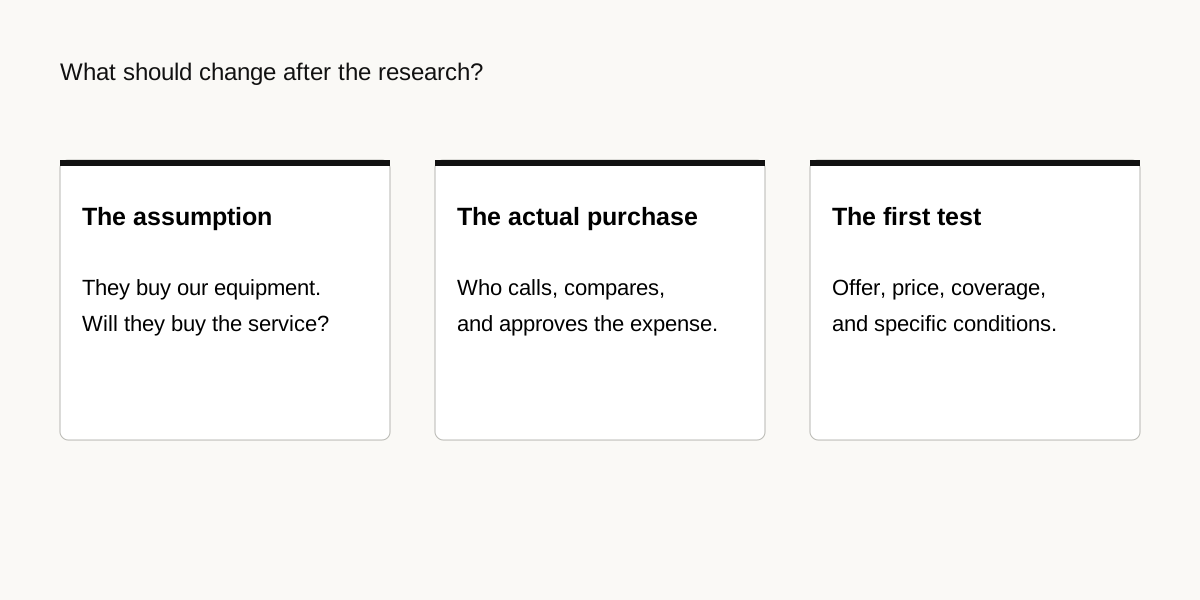
Selling the oven and selling maintenance involves answering different questions. The person who recommended buying the equipment may have little involvement in procuring the service. Existing trust can help you get a conversation. To move forward, the new offer has to make sense in this particular purchase.
Research begins there. What would the company need to understand to design a service someone could purchase, use, and justify to their manager?
What to examine through the five Cs
Useful research takes a decision leadership is about to make and examines it from several perspectives. This is our practical use of the five Cs. The questions and application express CRUDA's editorial judgment.
Culture — What feels normal in this market
How do people usually get things done? Perhaps the manager always calls the same technician because they trust him and can reach him on a Saturday. Perhaps accepting a monthly fee means justifying an expense that previously required approval only when something broke.
To understand that habit, ask how they chose their current provider and what they value about the relationship. The familiar technician is part of your actual competition, even if your company has a stronger presentation and more employees.
Context — When the need appears
A hotel that is opening, one renovating its kitchen, and one that has just suffered a breakdown may evaluate the same service differently. Find out what was happening when the last decision was made.
This may change when you sell. Perhaps maintenance should be introduced during installation, while the operation is being organized. Or after an inspection, when there is a visible problem the customer can assess. Those are hypotheses to investigate.
Category — Which alternatives buyers compare
The alternative might be a contract with another provider, a technician hired per visit, the internal team, or continuing to repair things when they break. Ask the buyer to explain which options they considered and why they rejected each one.
The SBA, the US agency supporting small businesses, includes demand, available alternatives, and pricing among its research questions. It also distinguishes existing data from direct research with buyers. That distinction helps connect market context with actual decisions. SBA guide
Company — What your business can sustain
Who answers outside normal hours? How many customers can one technician cover? How far can they travel? Are spare parts available? What does a faster response promise cost?
These questions have to be answered inside the operation. If the commercial appeal depends on weekend support, someone needs to cost and organize it. It is part of the product you are designing.
We develop the same thinking in our article on marketing, product, price, and distribution. Research can change what you sell before it changes how you advertise it.
Customer — Who experiences the problem and who pays
At the hotel, the kitchen may experience the problem, maintenance may evaluate the solution, and finance may approve the commitment. Research all three perspectives when they have a real role.
Who asked to look for alternatives? What did each person need to see? Who could stop the purchase? Who receives the complaint if the service fails? Those answers help you build an offer that can travel through the customer's organization.
From five perspectives to a decision
| Perspective | What you want to learn | What could change |
|---|---|---|
| Culture | Why they trust their usual technician | Continuity of contact and how you introduce your team |
| Context | When they review maintenance arrangements | When you offer the service |
| Category | What they compare with a monthly fee | The pricing structure and how you explain it |
| Company | What support you can deliver profitably | Coverage, hours, and conditions |
| Customer | Who recommends, uses, and approves | The evidence each person needs |
This matrix is a CRUDA tool applied to the hypothetical example. Each finding should be traceable to a conversation, a record, or an operational check. An entry filled with intuition remains a hypothesis.
How to ask questions that go beyond compliments
“Would you like us to offer maintenance?” leaves plenty of room for a polite response. Saying yes is easy when there is no contract, internal decision, or budget at stake yet.
Try reconstructing the most recent purchase or breakdown. What happened? Who did they call first? How long did they wait? What information did they seek? Who approved the expense? What made them stay with that provider?
Then you can show a concrete proposal. What it includes, what it costs, when the team responds, and what is excluded. Ask what they would need to review to purchase it and who else should see it. Record what prevents them from moving forward too.
Start with existing customers, lost opportunities, and companies choosing another solution today. Record the type of buyer in each conversation. Several interviews with one profile may reveal a tension you later need to measure with an appropriate sample. An enthusiastic conversation cannot establish market size.
Public conversations can help you find vocabulary, complaints, and questions. Industry data helps establish context. To decide whether your service fits, you need to get closer to the actual buying situation. Each source has value for the questions it can answer.
What to test before increasing the investment
Return to the hotel. Suppose the conversations reveal concern about weekend breakdowns. Your team confirms it can cover a limited area with certain parts available.
You can design a limited test in that area. Before offering it, agree on scope, price, exclusions, capacity, and an accountable service lead. Define the outcome that would justify expansion and the signal that would require a correction.
The test might show interest converting into contracts under those conditions. It might also reveal that everyone wants availability, but few will accept the price needed to sustain it. Or that customers value a scheduled inspection more than a promise of emergency support.
Each result calls for different work. Adjusting coverage, changing the offer, reviewing costs, or dropping a promise the company cannot yet deliver. It helps to make that decision while the investment is manageable.
The pilot provides evidence for that segment under those conditions. Before projecting into other markets or customers, examine what changes in distances, costs, habits, and procurement.
The decision that should change
Before starting, write one sentence with your team. “We are deciding whether to offer monthly maintenance to hotels in this area, under these conditions.” At the end, explain what you retained, what you changed, and what evidence supports it.
In our example, leadership might move from “sell maintenance to all our customers” to “test a scheduled service with nearby hotels, offered during installation with defined coverage.” That precision makes it possible to budget, organize delivery, and communicate something understandable.
Another question follows. Does the new line need its own name? That decision should consider the trust that already exists and what the buyer needs to recognize. We explore it in brand architecture.
CRUDA's approach begins with the purchase you want to understand. Curiosity serves the business when it helps challenge an internal certainty and design an offer the company can sustain.
Frequently asked questions
What should I research first if I already have customers?
How they currently solve the problem your new line would address. Find out who participates, what triggers the purchase, which alternatives they compare, and what conditions they need to change.
How many interviews do I need?
That depends on the diversity of buyers and the risk of the decision. An initial qualitative round can reveal differences and questions. Estimating demand or proportions requires an appropriate design and sample. Always explain the limits of what you learned.
Can research change the price or the service too?
Yes. It may reveal that the customer values different coverage, needs another way to pay, or requires a capability you still need to develop. That is a reason to research before finalizing the offer and campaign.
Can I research using social comments and AI tools?
They can help uncover questions and organize material. Verify sources and context, then test the hypotheses against real buyers and your company's records. Public comments carry participation biases and do not automatically represent your market.
Sources and scope
The applied five Cs method and decision recommendations express CRUDA's judgment. The kitchen equipment company and hotel are hypothetical examples, with no commercial results attributed to clients. The SBA guide provides methodological context on demand, alternatives, and direct research. Its US data does not estimate a Latin American market. Primary source