

Your company has grown. It does more, takes on different projects, or works in a new market. But when clients recommend you, they describe the company they knew ten years ago. Your team can see what’s changed. Your customers are still catching up.
Then a proposal appears: let's give it another name. Seems like a quick way to show the change. Until someone asks what will happen to everything it cost to build under the previous name.
That is the tension we are going to resolve: how to make the client understand what is new without losing what they already recognize and value.
What is brand architecture?
Brand architecture organizes the names under which a company presents its products and services, and shows how they are related. It helps decide when to share a brand, when to distinguish an offering, and when to build a different brand. The decision depends on what the buyer needs to understand and what the company can sustain. [1]
You don't need to know the models to recognize the problem. In the pages that follow, we'll name them, compare what they allow and what they require, and come back to your company with better questions.
In this article
First: what is a brand?
A brand is a set of meanings that people attribute to a company, a person or something that is offered commercially.
Editorial definition by Fran Herrera for CRUDA.
In simpler terms: it is what a name makes you think and hope. When someone recommends a supplier to you because “it delivers,” that word sums up an experience. If someone else tells you “it's cheap, but you have to be on top of it,” they are also talking about the brand.
The name and logo help identify. What you sell, how you serve, and what happens when there is a problem help form that expectation. You can influence it, but not completely decide what others think.
And what is brand architecture?
It is the way to organize the names with which you present your products and services, and to show what relationship they have. Decide what goes together, what stands out, and what gets support from another brand. [1]
Let's take a hypothetical situation: a company that manufactures windows begins to offer installation. You can call the service “[your brand] installation.” You can give it a different name and clarify who supports it. Or you can create an independent brand. It is a hypothetical example: the three options require explaining what the client contracts and who responds.
Four decisions that are often confused
Brand: what people think and expect from you.
Positioning: what place you want to occupy in the minds and hearts of your customers.
Identity: how you present yourself: name, logo, colors and language.
Architecture: how the names of your different offers are related.
Changing a logo can renew the presentation. It does not decide whether two businesses should share a name. That is why a change of image, by itself, is not a change of architecture.
Parent company and brand: what does the customer need to see?
Before choosing another name, separate two decisions that are often mixed: how you organize the company inside and how you present it to those who buy.
Think about Google, the company you know for its search engine and other services. Since a reorganization announced in 2015, Google has been part of a parent company called Alphabet. A parent company is a company that controls other companies. [2]
When announcing it, Google explained that Alphabet would not be a large consumer brand to bring together its products. The search engine was not renamed “Alphabet Search”. The company was reorganized, without asking the user to learn another name to search for. [2]

A holding is a company that owns shares in other companies. It is used to talk about property. Brand architecture answers another question: under what names are offers presented and how are they related to the customer?
What this means for your business
You can open a company in another country and continue using your brand. You can also have a single company and sell under several names. Legal and business decisions must be coordinated, but they are not equivalent.
The same happens within the company. Having an after-sales manager does not require you to create an after-sales brand. Opening a branch does not require you to name another business. A new name needs a reason that the buyer can understand.
Models are four ways of relating names
A main brand, separate brands, an endorsed brand and a sub-brand. They are reference points: a company can combine several relationships. Let's see what each one allows, what it requires and where it can fail. [1]
1. Main brand: grow with a well-known name.
If the new continues what your customers already value, the familiar name can be a starting point. This is the first alternative.
It is the main brand model, also called branded house. The idea is simple: the well-known name accompanies different offers. Each product may have its own name, but the common brand takes center stage.

Apple sells Mac computers, iPad tablets, and iPhone phones. The buyer can distinguish the products and, at the same time, recognize the same brand behind them. It is a pedagogical reading: product names also have their own force. [3]
What can the company gain?
A new offer can be based on a brand that the customer already recognizes. Part of the communication effort is concentrated and it is easier to show a family of services. For a window company, adding installation under your name can help explain that you offer a complete solution.
What can go wrong
Reputation becomes more connected: a non-compliance in installation can affect trust in the windows. Additionally, if the name means something too narrow, the new activity may not seem credible. Just because they know who you are doesn't mean they consider you capable of doing anything.
Before choosing it: ask what the current name brings to the new offer and what expectation it requires it to meet. If you only bring familiarity, you still need to demonstrate your ability.
2. Independent brands: distinguish proposals.
But sometimes the shared name stops helping: it makes you wait for the same thing where you need to explain an important difference. So it is worth evaluating different brands.
It is known as house of brands or house of brands. The company brings together brands that the buyer can choose separately. The group name does not have to be on the front of each product.
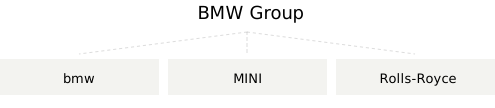
BMW Group is the business group. Within it are the car brands BMW, MINI and Rolls-Royce; also BMW Motorrad, for motorcycles. A MINI is not presented to the buyer as “BMW MINI”. The group presents BMW from sportsmanship and Rolls-Royce from luxury and craftsmanship. They share an owner, but they do not seek to arouse exactly the same expectation. [5]
In clothing, Inditex is the group to which Zara, Bershka and Massimo Dutti belong, among other brands. They are stores with their own names and presentations. The comparison with BMW shows that the separation does not respond only to a price scale: it also allows us to distinguish styles and proposals. [6]
What can the company gain?
Each brand can build a more specific personality and offering. It also allows you to preserve the name of an acquired company when its customers already value it. The buyer does not need to learn the entire structure of the group to choose one of its brands.
What can go wrong
Each name needs to become known and sustain a reason for being chosen. That requires resources, materials and management. If two brands offer almost the same thing, they can divide efforts and confuse. Furthermore, separating names does not guarantee isolating problems: common property may be public.
Before choosing it: explain what difference your own brand needs and why a line within the existing brand would not be enough. Having more brands does not, by itself, demonstrate more specialization.
3. Endorsed brand: a name with a reference.
Separating has a cost: some of the familiarity may be left behind. What if the offer needs a proper name, but it also helps to know who is behind it?
An endorsed brand, also called endorsed brand, presents itself with its own identity and shows who endorses it. In English, “by” means “for”: in these names it functions as a visible sign of relationship.

Courtyard by Marriott is a hotel brand. Courtyard identifies the offer; Marriott provides a reference of origin. DoubleTree by Hilton uses a similar relationship: the guest sees a personal name and the link to Hilton. [7][8]
In hospitality, sharing a group does not mean being the same hotel
Marriott International is the hotel company whose suite of brands includes The Ritz-Carlton, St. Regis, W and EDITION, as well as Courtyard. Hilton brings together, among others, Waldorf Astoria and Conrad. Marriott presents St. Regis through refined service and W through design and busy spaces. Both are in luxury: distinguishing brands also allows us to offer different experiences at a high level. [7][8]
For those who book, knowing that they belong to a group can be useful. You still need to understand what experience that hotel offers. Nor does the brand relationship indicate, by itself, who owns the building.
Backup advantage and limit
The advantage: an offer can build its own name without losing all reference to a well-known brand.
The risk: the endorsement generates expectations that must be met. And keeping two names may require more explanation. If the client does not know who they support, that link can contribute little.
Before choosing it: ask what specific question the endorsement solves. Who answers? Where does the service come from? What experience sustains you? The name helps when that relationship means something to the buyer.
4. Subbrand: distinguish without moving away.
There is another possibility: that the client first recognizes the family and then understands what makes each offer different.
A sub-brand distinguishes an offering by maintaining a close relationship with a parent brand. Think of it as a name that allows you to recognize something particular without erasing the family to which it belongs.

Mercado Libre allows you to buy and sell. Mercado Pago offers financial and payment services. Shipping Market brings together logistics services. The company presents them as parts of the same set of services. Names help distinguish tasks and preserve a recognizable relationship. It is an example of a family of names; It does not imply that all three have the same weight or role. [9]
In clothing, Polo Ralph Lauren and Ralph Lauren Purple Label retain Ralph Lauren in their names. Purple Label identifies a luxury offering; Polo has its own proposal. There are differences within a shared universe, without turning each offer into a completely foreign brand. [10][11]
What can the company gain?
It can explain a specialty, line, or level of service while retaining some of the familiarity of the main name. It is useful when the buyer needs to distinguish, but the relationship with what exists still helps.
What can go wrong
If each small variation is given a different name, the customer ends up studying a catalog of labels. It can also be difficult to understand why a line costs more or includes less. The difference has to appear in the product, the service and the commercial explanation.
How is it different from the endorsement? In a sub-brand, the main name is still closely linked to the offering. In a supported brand, its own identity usually has more prominence. There are intermediate zones; It matters what the relationship conveys, not just where the logo is placed. [1]
How to choose between the four models.
Models describe relationships, not steps of maturity. A large company does not need many brands because it is large. A little girl should not wear just one out of obligation. [1]
| Model | What allows | What requires or risks |
|---|---|---|
| Main brand | Submit several offers with a known reference. | A common expectation that everyone must meet. One problem can affect the whole. |
| Independent brands | Distinguish proposals and preserve valuable names. | Build and manage recognition for each one. You can duplicate efforts. |
| Endorsed brand | Give your own identity and show who is behind it. | That the support contributes something and the offer meets that expectation. Two names can be confusing. |
| Subbrand | Distinguish an offer within a recognizable family. | Let the difference be clear. Too many labels complicate the choice. |
Try it with a concrete decision
Let's go back to the window company. If the facility completes what it already promises, you could present it as a branded service. If you serve a different need, an identifiable line can help. An independent brand deserves study when the current name makes you expect something that that offer cannot or does not want to deliver.
CRUDA's criterion: an internal difference deserves to be visible when something important for the buyer changes. A new supplier, a different margin or a separate team is not enough, on its own, to justify another brand.
Up to this point we saw the alternatives separately. In a real company they can coexist. Amazon shows that coexistence; Marriott, how to reorganize it when the business changes.
Mixed architecture: what Amazon shows.
The question is no longer which of the four models wins. It's what relationship helps in every part of the business. Amazon allows you to see it on a single map.
Amazon is known for its online store, but it also offers music and technology for businesses. In some offers he repeats his name. In others, the client finds a different identity. Looking at both things avoids confusing a large company with a single brand used in the same way.
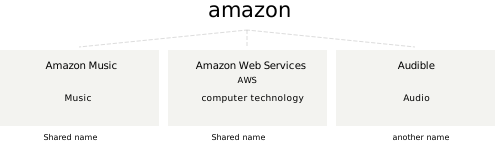
Amazon Music allows you to listen to music. Amazon Web Services, or AWS, provides computing services over the Internet, such as the ability to store information and run applications. Both retain Amazon in their name. Audible offers audio content and has its own name. They are activities that Amazon presents within its business. [4]
What allows us to observe
Repeating Amazon makes a relationship visible. But it doesn't alone explain why you should trust a company's data to AWS. Each offer needs to demonstrate its ability in its field. Keeping another name allows, in turn, to develop a more specific identity.
The question for your business
If you add an activity, does the current name help the client understand it or does it require so many explanations that it ends up making it difficult? The answer may vary between services of the same group.
For your company, this opens up a possibility: share the name where it helps and keep another where it makes sense. The next question is how to make that change if there are already several names with history.
Marriott: uniting a part without erasing the differences.
When you buy another company, you also receive names that their customers already know. What do you unify without deleting a useful reference? Marriott offers a case: after integrating Starwood, Marriott Rewards, The Ritz-Carlton Rewards and Starwood Preferred Guest, known as SPG, coexisted. There were three loyalty programs, that is, systems of points and benefits for those who book again. [12][13]
Marriott unified the three programs in August 2018. In February 2019, it introduced a common name: Marriott Bonvoy. [12][13]
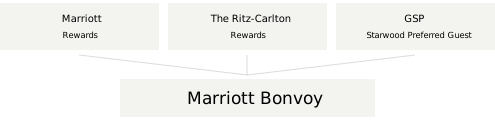
The hotels retained their different brands. The Ritz-Carlton was not renamed “Hotel Bonvoy.” What was gathered was the relationship of benefits of the traveler with the whole. [7][12]
What problem were you looking to solve?
Marriott introduced Bonvoy as a common way to access benefits and experiences across its hotel portfolio. For the traveler, the name could connect different rooms. For the company, it offered a co-brand for that relationship. That was the announced purpose; does not in itself prove that the name change caused more sales. [12]
What it teaches us and what it demands
Our reading: there is no need to choose between unifying absolutely everything and leaving everything separate. You can unite what the client uses in common and preserve what needs to be distinguished.
The counterpart is operational. A common name requires explaining accounts, benefits and conditions clearly. If the client must figure out how the union works on their own, the rebrand is incomplete.
The change shows where to look before changing all the signs: what can become common and what difference is still useful. In companies where the client buys a creative look, that same question takes on another nuance: does each specialty need a brand?
Does each specialty need another brand?
In architecture and interior design, a client can hire a building, an interior or an object. The order changes, but you can search for the same criteria. Lissoni & Partners and Kelly Wearstler allow us to look at this continuity without confusing it with an identical offer.
Lissoni & Partners: specialties with a visible link
The studio brings together architecture, interiors, product design and visual communication. Their presentation includes Lissoni Casal Ribeiro, Lissoni Associati, Lissoni Design and Lissoni Graphx. The specialty changes; the surname maintains a recognizable relationship. [14]
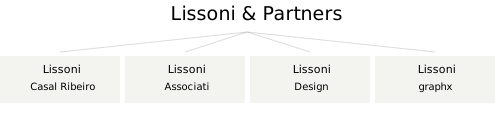
The reading we took to a lighting client was concrete: a new division does not have to start from an unknown name. You can explain what you do and keep a reference that already helps you understand the criteria of the whole.
Kelly Wearstler: from the interior to the object
Their site features interior projects, product collaborations and a store with furniture, lighting and objects. The name Kelly Wearstler allows you to explore these activities within the same universe. Specific names also appear, such as Side Hustle Gallery; Not everything is reduced to an identical label. [15]
What is useful for a design company: selling an object and developing an interior are different tasks, but they can share a vision. The benefit is recognizing that continuity. The requirement is to demonstrate it in each offer and clarify what work the studio does, what its teams do and what corresponds to a collaboration.
Maps show commercial presentation, not ownership or contracts. Sharing a look does not imply the personal participation of the founder in each assignment.
A broad brand needs to show who knows how to do what.
Keeping a name avoids starting from scratch in each specialty. But it opens up a responsibility: making visible the experience behind each work. That's where the teams and their capabilities matter.
BIG: the client can understand a joint capability
BIG stands for Bjarke Ingels Group, the studio founded by architect Bjarke Ingels. It presents its joint work with the expression BIG LEAP: landscape, engineering, architecture, planning and products. They are different disciplines that are shown within the same study. [16]
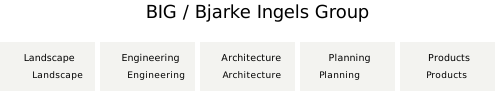
The observation that matters: five capabilities do not require building five independent brands. If the client needs you to work together, a common presentation can help explain that collaboration. The limit appears when the breadth makes it difficult to recognize who has the specific experience for each assignment.
Zaha Hadid: the legacy of a name and its limits
ZHA is the architecture office founded by Zaha Hadid. Its history includes CODE, a group dedicated to calculation and design that investigates new ways of designing and building. That specialty can be made visible within the office. [17]
There is an important nuance: Zaha Hadid Design, dedicated to furniture and objects, today belongs to the Zaha Hadid Foundation. The foundation clarifies that the architecture office is an independent entity that operates separately. It is not appropriate to draw them as departments of a single company. [18]
Lissoni, Wearstler, BIG and ZHA leave a useful question: does the client need another name or does he need to see the specialty and those who practice it better? Breadth can help, as long as it doesn't blur what each team knows how to do.
FAENA: what must feel the same when the offer changes?
Showing capabilities solves one part. In luxury it also matters what someone expects to feel when moving from one experience to another. There the relationship between names needs a recognizable intention.
FAENA bears the last name of Alan Faena, an Argentine businessman who went from fashion to hotel and real estate projects, together with partners and collaborators. [21]
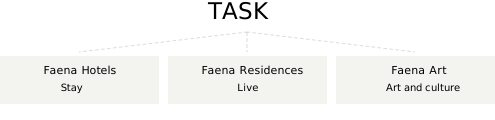
The brand allows you to approach hotels, residences and cultural proposals. They are different activities: staying, living and participating in an artistic experience are not the same purchase or the same relationship. The name Faena connects them. [19][20]
What we see from CRUDA
Our reading: Faena brings together art, design and hospitality under a recognizable way of experiencing a place. The surname proposes something that can continue even if the service changes.
Positioning and architecture meet here. Positioning asks what place the brand wants to occupy in the mind and heart. Architecture decides how the names of the offers that seek to build that place are related.
The advantage and the requirement
A common name can help one experience spark interest in another. But that connection is not sustained only by the last name. The care of the space, the attention and the cultural decisions have to give reasons to recognize the same brand.
For a luxury entrepreneur, the question is concrete: if the client moves from one offer to another, what should he continue to feel and what does he need to find differently? This response allows us to evaluate whether sharing the name makes sense, beyond the fact that all offers belong to the same owner.
Faena Art presents itself as a non-profit organization. The map shows a public name and experience link; not a corporate organizational chart or equality of business models. [20]
A CRUDA case: when the name is not enough.
This distinction came about when working with a lighting company. It had grown in services and markets, but the client did not interpret its capabilities in the same way in all of them. In the home market I knew the trajectory and the team. In the new one, he trusted the founder above all.
The company brought together design, product sales and different ways of handling projects. Each activity had an internal logic. Our job was to examine which ones needed a name of their own and which ones could be presented together.
Share, differentiate and demonstrate
Sharing: We proposed to bring together compatible offers under the existing business name. Opening another market did not by itself justify another name. The trajectory could be presented as proof, although recognition had to be built there.
Differentiate: the design studio had to be able to be explained as a service with its own fees. In commercial conversations, the relationship between recommending lighting and selling the products could raise questions about the independence of the advice. A separate identity deserved evaluation, along with the actual conditions of service.
Demonstrate: The founder would retain creative direction and oversight on crucial projects. The content also had to show how the senior designers worked. His ability needed to be made visible to expand confidence in the team.
The question that avoided reducing everything to names
What did the client need to understand better: the difference between services, the relationship between companies or who was going to take charge of their project? Each answer required a different action.
The offer had to be organized and confidence increased in those who delivered it. Another brand, on its own, would not have demonstrated the capabilities of the senior designers or made it clear when the founder would be involved. The architecture had to be accompanied by evidence of the work and clear care agreements.
Anonymized real case, based on CRUDA's experience and documentation. The diagnosis and proposed orientation are described. No implementation results or measured business improvements are attributed.
Do you need another brand? Questions before deciding.
Your company grew, but the client still sees a part. Now you can distinguish if you need to know a capacity, differentiate an offer or understand the relationship between brands.
Another brand or product line?
If you change the size, format, or feature, try a description or line name first. If a core promise changes and the current name makes it difficult to believe, consider another identity. Ask what the buyer interprets.
Does the endorsement help or make the specialty less clear?
Show the same offer with and without the known name. Ask what it does, who it is for, and what the customer expects to receive. If the name gives confidence but hides the specialty, explore a sub-brand or endorsement.
Should the name of an acquired company be changed?
First find out what recognition it has. Do clients ask for it by name? What do they value? What do you think will change with the new owner? You can keep, backup or migrate. Unifying them immediately can erase a reference that still helps sell.
Can we sell at different prices with a single brand?
Yes it can be possible, if the client understands what changes between the offers. Separating can be convenient when expectations are difficult to hold together. There is no price at which another brand becomes mandatory.
Who responds when something goes wrong?
If an offer is presented under several names, explain who is selling, who provides the service, and who assists afterward. A drawing of marks does not resolve a confusing derivation. This clarity is also part of what the customer ends up believing about the company.
Before approving another name, I wrote a sentence: “Today the client believes that we do ___; they need to understand ___; let's demonstrate it with ___.” Then I chose the brand relationship that helps close that distance. The drawing will be clearer when the decision is already clear.
Sources: everyday concepts and examples.
Sources verify names, relationships and announced changes. Comparison of advantages, risks and applications is CRUDA editorial analysis; not a study of commercial results of those companies.
[1] Aaker and Joachimsthaler. The Brand Relationship Spectrum (2000).
California Management Review. Conceptual framework; copy of the article in an external repository.
[2] Google. G is for Google (2015).
Alphabet announcement and distinction between parent company and consumer brand.
[3] Apple. Official catalog.
Presentation of Mac, iPad and iPhone within Apple.
[4] Amazon. What We Do.
Amazon Music, Amazon Web Services and other activities with different names.
[5] BMW Group. Brands and Business Segments.
BMW, MINI, Rolls-Royce and BMW Motorrad. The article map selects car brands.
[6] Inditex. Brands of the group.
Zara, Bershka and Massimo Dutti, among others. Partial selection.
[7] Marriott. Hotel Brands.
Hotel brands and relationship with Marriott Bonvoy. It does not prove ownership of each property.
Sources: services, fashion and transformation.
[8] Hilton. Our Hotel Brands.
DoubleTree by Hilton, Waldorf Astoria and Conrad within the set of brands.
[9] MercadoLibre. Annual report 2025, presented to the SEC.
Mercado Libre, Mercado Pago and Mercado Shipping as parts of its set of services.
[10] Ralph Lauren. Brands.
Presentation of offer families, including Polo.
[11] Ralph Lauren. Luxury.
Presentation of Ralph Lauren Purple Label within its luxury offering.
[12] Marriott. Marriott Bonvoy Announcement, January 16, 2019
Company release distributed by PR Newswire. Replacement of three names of fidelity and announced purpose.
[13] Marriott. Letter to shareholders about 2018.
Unification of programs in August 2018 and presentation of Bonvoy in February 2019.
[14] Lissoni & Partners. About Us.
Specialties, teams and names of practices. The map selection is not a legal organization chart.
Sources: architecture, interior design and FAENA.
[15] Kelly Wearstler. Official site.
Interiors, products, collaborations, store and Side Hustle Gallery.
[16] BIG. About.
Bjarke Ingels Group and BIG LEAP: Landscape, Engineering, Architecture, Planning, Products.
[17] ZHA. Our Story.
Origin of the Computing and Design office and research group, CODE.
[18] Zaha Hadid Foundation. The Foundation.
Zaha Hadid Design belongs to the foundation; The architecture office operates independently.
[19] Faena. Official site.
Presentation of destinations, residences, art and experiences. Separate editorial interpretation of results.
[20] Faena Art. Official site.
Describes its status as a non-profit organization and its artistic activity.
[21] Alan Faena. Citi Private Bank profile and interview.
Track in fashion and district development, partners and personal vision. He is not presented as an architect.
Selective maps for commercial presentation. They do not represent ownership, contracts or complete legal structures. Anonymized lighting case: diagnosis and proposal, no results attributed. Sources consulted on November 8, 2026.