

A proposal lands on the leadership team’s desk. It lays out what to publish, where, and when. The question comes before any of that. How will this help buyers understand our value and ask for our brand?
That was the question we explored while preparing a proposal for AGP sGlass México. A company may know its product very well and have strong relationships in its industry. Still, you need to explain your difference to those who influence the next purchase. That distance is the topic of this article.
How is preference built for a B2B brand?
For a buyer to ask for your brand, they need to understand what difference it makes, verify that this difference is real and know how to achieve it. When you sell through distributors or other companies, you also need them to be able to explain and deliver that value. Communication helps connect those parts; by itself it does not guarantee the election.
B2B means that one company sells to another company. It can be glass for an armored vehicle, an engine for a factory or cement for a construction company. Behind every purchase there are still people who need to choose and be responsible for that decision.
In this article
A question we explored in a proposal for AGP sGlass México
AGP sGlass manufactures protective glass solutions. The case of this article corresponds to AGP sGlass México, not AGP Group. Its civilian armor business includes materials for vehicles: one part of a system that must protect its occupants. For this article we focus on that business in Mexico, not on all the group's activities. [1]
In our proposal work for AGP sGlass México, the problem was specific: how to get more buyers to know the differences in their glass and request the brand when ordering shielding. That meant reaching those who decide or recommend, in addition to accompanying the armorers who buy and integrate the product.
The task required connecting communication and business: who we would help, what they needed to understand and how we would facilitate their decision. There were technical skills to explain and experience to share. The challenge was to translate that value into a reason that the buyer could understand and convey.
The buyer does not necessarily buy directly
A armorer is a company that prepares a vehicle to protect those who travel in it. You buy components, integrate them and deliver the work. Whoever orders that vehicle can choose the armor without knowing who manufactured each material.
There appears a question that surpasses the sector: how can a brand matter in the decision when it is part of something that another company sells?
Reputation among those who already work with you does not explain, by itself, what someone who does not yet know you understands.
CRUDA’s proposal for AGP sGlass México. No implementation results are presented nor private exchanges reproduced.
Who has to order your brand?
Before choosing a message, it is advisable to follow the purchase journey. In the same operation there may be someone who recommends, someone who pays, someone who installs and someone who uses the product. They don't always look for the same thing or need the same explanation.
The AGP sGlass proposal included dealers, security managers and buyers of vehicles to be armored, in addition to the armorers themselves. A dealership sells vehicles. A security manager evaluates needs and risks. The armorer does the job. A person can fulfill more than one role; The map is used to investigate, not to assume a single route.
Being known and being asked for are different things.
To recognize a name is to know that it exists. Preferring it is leaning toward it among alternatives. Asking for it is taking a specific step: mentioning it in a query, including it in a quote, or requesting that it be used in a project.
If you sell materials for a project, your first objective may be for the architect to include them in the project. If you sell industrial equipment, maintenance may recommend your service. You don't need to be famous to everyone: you need to make sense to those who influence that purchase.
Before we decide how to reach those people, we need to understand what they lack to choose from. The company may be thinking about communicating more technology while the buyer is trying to solve a much simpler question.
What does the buyer need to understand to choose?
Imagine someone orders an armored vehicle. You can trust the company doing the work and still not know what to ask about its components. It is a possible situation that we need to investigate; not a conclusion about all AGP sGlass clients.
If that were the difficulty, repeating that a manufacturer has experience would not be enough. The person should be helped to recognize what differences matter, where to check them, and how to request them in their budget.
The question that changes work
Instead of starting with “what do we want to say about ourselves?”, we start with “what is this person trying to solve and what are we not understanding about their experience?” The answer may change the message, the evidence we show, and who we need to involve.
At CRUDA we call insight a hidden truth from the client's perspective that, when made visible, allows us to understand something that we did not see before. It can be something everyday that that person experiences without having put it into words. Julian Cole describes it as a revealing truth that changes our reading of the problem. [9]
It is not enough to write a sentence that sounds profound. You have to listen to specific purchases, observe what happened and contrast the interpretation. Nor does finding an insight guarantee sales: understanding and executing are related jobs, with different demands.
Now yes: what the examples teach us
The next three cases help us think about how to explain a difference once we understand the buyer. Intel makes a piece that was inside recognizable. Dolby allows you to experience a capacity. GORE-TEX connects a material with a promise and a support. Each one solves a different part of the problem.
How to make visible what the client does not see? Intel.
Intel is a company that manufactures chips, small electronic parts. One of its products is the processor: the part that executes instructions for a computer to work. In this simplified route, Intel sells those components to equipment manufacturers; the user buys the finished computer. Dell, HP and Lenovo offer computers with Intel processors. Not all of their models use the same chip manufacturer. [10]
Intel was already well-known among manufacturers, but many people outside the industry didn't understand what a processor was or why it mattered who made it. In 1991 it launched Intel Inside, which means “Intel inside.” The name and label helped identify the component within the equipment. [2][3]
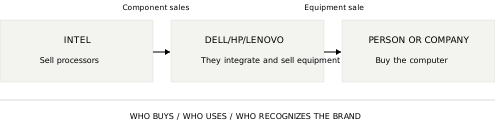
The campaign combined its own ads with financial support for manufacturers that incorporated the brand in their products and advertising. There was a reason for those companies to participate: Intel's name could also help them explain the value of their computers. [2]
What we can learn
Our reading: the buyer could begin to recognize a component without becoming an engineer. The brand gave him a reference to ask and compare. The lesson for an industrial company is to find what part of its work deserves to become understandable before the purchase.
For AGP sGlass, the equivalent question is what someone who orders shielding would have to understand for the name of the glass to matter in their decision. Intel shows the mechanism; does not authorize copying a label. First you have to give it a meaning that the buyer and the armorer can explain.
How to prove the difference? What Dolby shows.
Maybe you saw the word Dolby when starting a movie or looking at the features of a television. Dolby develops sound and image technologies that other companies incorporate into their products and services. You don't need to buy a “Dolby brand” movie to find it.
Dolby Atmos is a sound technology that can give the sensation that what you hear is coming from different directions. Dolby Vision works on the image. Netflix offers certain titles with these technologies, when the plan and equipment allow them to be played. They are not available in the same way in their entire catalog or on any television. [5][6]
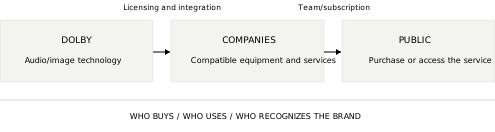
A difference that can be experienced
Imagine listening to a rain scene. You can explain for several minutes how the audio is processed. Or you can make the person hear the difference with a well-prepared demonstration. This is our reading of the case: experience can help you understand something that a list of specifications leaves behind.
That has a direct translation for other businesses. A window supplier could show how the noise changes with a comparable test. A lighting company can show what the same surface looks like under two solutions. These are application examples, not results attributed to Dolby.
If your difference can be seen, heard, or experienced, ask yourself why you are only describing it.
Back to AGP sGlass: a technical difference needs proper proof. Some properties can be explained with comparisons; others require specialized testing and documentation. The task is to help understand what each test demonstrates. GORE-TEX allows you to see how an everyday promise and its support are connected.
What backs up the promise? The GORE-TEX lesson.
GORE-TEX is a brand of material technologies used in clothing and footwear. Among their products there are very thin layers that are incorporated into a garment or shoe to prevent water from passing through and allowing moisture vapor to escape. The manufacturer of the garment and the technology it incorporates may have different names. [7]
For example, Adidas sells certain models with GORE-TEX. You buy an Adidas product that incorporates that technology; It doesn't mean that all Adidas shoes have it. [8]
GORE-TEX explains that its brand also represents a quality control system. Their promise to keep you dry has a limited warranty on the products covered. There are different conditions and lines: it is not appropriate to extend that guarantee to any product related to Gore. [7]
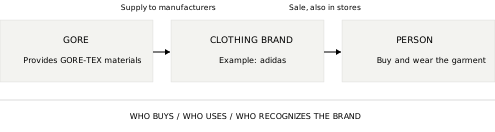
Translate without deleting the test
For those who go out for a walk in the rain, understanding what the material is for is more immediate than knowing its composition. Our reading is that an everyday promise and an identifiable endorsement work together. Simple language opens the conversation; The details allow you to evaluate whether the offer corresponds to what you need.
In a technical company, translating is not about replacing a report with a slogan. It is to help the buyer understand what problem that report addresses, what it demonstrates and what its limits are.
For AGP sGlass, learning is accompanying each argument with its meaning and evidence: what changes for those who use the vehicle, what supports it and under what conditions. Knowing a brand can spark interest; understanding and verifying its contribution allows it to be evaluated. We can now return to the purchasing journey.
Let's go back to AGP sGlass: how does that value reach the customer?
The initial question begins to have a concrete answer. AGP sGlass needs those who influence a shield to understand their input and be able to request it. At the same time, the armorer must be able to explain that contribution within the complete work that is delivered.
Our recommendation is to work on both sides of that relationship: help whoever chooses to ask better questions and give the business partner useful arguments and evidence to answer them. The experience of leaders and specialists can make that explanation closer.
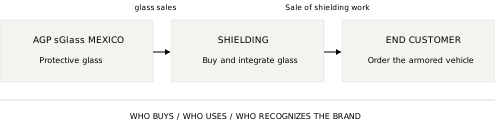
Make visible the criterion that already exists
An executive can explain what questions to ask before choosing, what differences deserve attention, and what a buyer can check. You can tell how a decision is made without revealing confidential information. This content allows someone who does not yet know you to come closer to your way of thinking.
Our recommendation is to connect each explanation with evidence that the team and partners can also use. A clear guide, a demonstration, or a well-documented case should serve even if the director is not present in that conversation.
The personal voice can open a door. The rest of the company has to be able to sustain what is said: technical knowledge, attention, documentation and monitoring. If everything depends on the executive responding to each message, there is still work to do.
Up to this point we are talking about facilitating a specific decision. But in a management meeting another question may arise: what if we also need more people to know our name before needing the product? That's where Aramco and Globant come in.
Do we need to be known outside the industry?
Sometimes a company also seeks to build familiarity with a broader audience. Aramco serves to distinguish that task from getting someone to order a specific component.
Aramco is a Saudi Arabian energy company. Works with oil, gas and chemicals. Let's take a part of your business: you sell refined fuels wholesale to companies that market them and to industrial customers. Refining means transforming oil into usable products, such as fuel. [15]
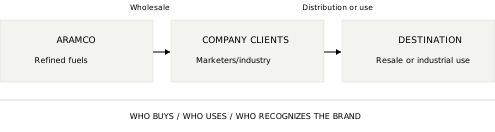
In 2020 it announced a global sponsorship of Formula 1, the international motorsport championship. A sponsorship allows a brand to be associated with the event in exchange for agreed upon resources and rights. Whoever sees Aramco in a race does not therefore become a wholesale fuel buyer. [11]
Why appear in front of so many people?
Our reading: business and communication can have audiences of different sizes. Aramco can sell to organizations while seeking familiarity with its name among a broader audience. The F1 environment also allows us to talk about engineering and performance; The announcement included technological collaboration goals. [11]
That's different from Intel Inside. Intel identifies a part of the computer you buy. Aramco sponsorship makes a company visible in a show that you follow. It does not demonstrate purchasing preference or business results on its own.
For AGP sGlass, this forces us to choose priorities: is the obstacle that the right buyers do not know the brand, or that they know it but do not understand what it brings? The answer defines where to invest. The size of another company's sponsorship doesn't answer that question.
Can visibility show capability? Globant.
Globant provides a nuance: presence in a known setting can also coexist with visible technical work. Born in Argentina, she develops digital programs and experiences for other organizations. The organization commissions the work; Your employees or clients use the result.
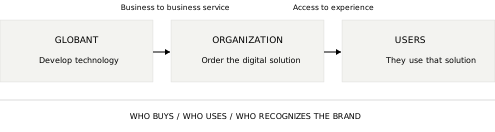
F1 is a documented example of an organization he works with. In 2024 they announced an agreement for digital experiences. In May 2026, Globant reported on its work on the official F1 app for those attending races. The announcements do not publish the financial conditions of the agreement. [12][16]
Sponsorship is another relationship
Franco Colapinto is an Argentine pilot. In 2023, Globant announced its support for the driver's debut in Formula 2 in 2024. In August 2024, it also announced an alliance with Williams, the team with which Colapinto went on to race in F1. Driver, team and championship are different links. [13][14]
Our read: Globant can showcase its capabilities through the work it does and build familiarity through its brand associations. An amateur can know it without being its client; Anyone who buys technology for a company can also be a hobbyist.
For AGP sGlass, the lesson would be to choose spaces where its knowledge is useful and relate that presence to accessible evidence. Familiarity can open up the conversation; The buyer still needs to evaluate the offer and find someone to deliver it. That is why the next step returns to a specific purchase, not to choosing a sponsorship.
How to bring it to your company?
Choose a specific purchase that you want to understand better. A work, the renewal of a contract, the choice of a supplier or an order that arrived through a distributor. Avoid starting with “our customer” as if everyone buys the same way.
| What to check | Specific question | What to do with the answer |
|---|---|---|
| The purchase | Who recommends, pays and uses? | Choose who we need to explain best. |
| The difference | What changes for that person? | Translate capabilities into understandable consequences. |
| The test | What do you need to check? | Gather relevant demonstrations, documents or cases. |
| access | How can you order from us and get from us? | Agree on route and response with sales and partners. |
You can start with conversations about recent trades: one you won, one you lost, and one that was delayed. This selection serves to explore questions, not to statistically represent the entire market.
Ask what happened: who proposed the options, what was worrying, what information was missing, and what advanced or slowed down the decision. I asked for examples. “We value quality” says little until you understand what quality means to that person and what allowed them to recognize it.
Contrast those answers with sales, service, and distributors. If an interesting explanation appears, also look for cases that contradict it. A phrase that we like is not yet a confirmed truth.
When is it appropriate to invest in what they ask you for?
It's a good idea to explore this strategy when your brand choice may matter to the buyer, there is a difference you can demonstrate, and there is a way to request and get your offer. The examples above show possibilities; They do not force every industrial company to do massive advertising.
If the decision occurs between specialists
Perhaps the best job is helping architects, engineers or purchasing managers evaluate your solution. You may need clear documentation, samples, training or detailed cases before a general public campaign. Being easy to recommend in a technical conversation also counts.
If the buyer wants your product, but can't find it
The priority may be availability, budget, installation or dealer response. More interest alone does not fix those problems. Check where the route cuts off before expanding communication.
If you still don't understand the difference
There is a task of explanation there: what changes for that person, how it is tested and why they should care. You can try out a guide or demo with real buyers and see what they understand without help.
How to evaluate if we are making progress?
Record the starting point. See if queries appear that mention the brand, if it is included in quotes, and if partners can explain its value. Review opportunities and reasons for choosing or discarding along with sales. They are signs to learn; They do not alone prove that the content caused a sale.
A business-wise review requires agreeing on what we are going to look at and recognizing what else has changed over that period: pricing, availability, competition and business activity.
Let's go back to the direction question.
“How do we get them to order our brand?” It seems like a communication question. When working on it, it forces us to look at what the buyer understands, who advises them, how they recognize a difference and what happens when they try to buy.
The journey leaves us with three tasks: that the difference is understood, that it can be verified and that there is a clear way to request it. Broad visibility can accompany them when there is a reason to invest in it. It does not replace any of the three.
For AGP sGlass México, our proposal is based on its capabilities and the experience of its team, but it has to reach the buyer's decision. The goal is for someone to be able to understand, explain and request that value, even when there is no company representative in the conversation.
A question for your next meeting
Take a recent business proposal and ask the team: “If the client had to explain why they were considering us to someone who wasn't in this meeting, what could they say and what would they back it up with?”
If the answer requires you to explain everything again, you already have a place to start.
Article based on public sources and on the criteria of the CRUDA proposal work for AGP sGlass México. Facts, interpretation and recommendations are distinguished. No sales results are attributed to the jobs described.
Sources and scope
[1] AGP sGlass · Solutions for civil vehicles
https://agpglass.com/en/civil/
Corporate source to explain the activity of the civil armor business. Their capabilities are not extrapolated to all units in the group.
[2] Intel · End User Marketing and Intel Inside
https://www.intel.com/content/www/us/en/history/virtual-vault/articles/end-user-marketing-intel-inside.html
Corporate history of the 1991 program: explanation to the consumer and advertising collaboration with manufacturers. It is not an independent causal evaluation.
[3] Intel · Inside Intel Inside, 1991
https://timeline.intel.com/1991/inside-intel-inside
History of the label and advertising support of computer manufacturers.
[4] Intel · Intel Inside Renewal, 2025
https://newsroom.intel.com/corporate/postcard-from-vision-a-refreshed-intel-brand-takes-center-stage
Documents the campaign renewal. It does not demonstrate commercial recovery nor does it alone explain Intel's competitive evolution.
[5] Dolby · Netflix Experience
https://www.dolby.com/experience/netflix
Describes Dolby Atmos and Dolby Vision and their availability depending on the content, device and plan.
[6] Netflix · Dolby Atmos
https://help.netflix.com/es-es/node/64066
Checks the availability of certain titles and playback requirements. It does not imply presence in the entire offer.
Sources and scope · continued
[7] GORE-TEX · Frequently asked questions
https://www.gore-tex.com/en_uk/support/frequently-asked-questions
Explains materials, quality system and scope of warranty. The keep dry promise applies to the products covered, not every line linked to Gore.
[8] adidas · GORE-TEX clothing and footwear
https://www.adidas.com/us/gore_tex
Example of a recognizable brand that offers products with this technology. It does not mean that the entire adidas catalog incorporates it.
[9] Julian Cole · Interview in Smarter Marketer, 08/25/2026
https://rocketagency.com.au/podcast/julian-cole-on-strategy-that-works-in-2026
The transcript defines insight as a revealing truth that allows you to look at the problem in another way. The formulation of the article is from CRUDA.
[10] Dell Technologies · Business PC Comparison
https://www.delltechnologies.com/asset/en-us/solutions/business-solutions/selling-competitive/principled-technologies-study-a-comparison-of-pc-oem-security-features.pdf
Document hosted by Dell that includes Intel-based Dell, HP and Lenovo PCs. It only supports manufacturers' examples, not comparative superiority.
[11] Aramco · Global agreement with Formula 1 · 2020
https://www.aramco.com/en/news-media/news/2020/aramco-announces-partnership-with-formula-1
Official announcement: sponsorship and declared objectives. No sales or environmental results are attributed to the agreement.
[12] Globant · Alliance with Formula 1 · 05/02/2024
https://www.globant.com/news/globant-formula-1-partnership
Agreement for digital experiences; It is distinguished from support for a driver or a team.
Sources and scope · continued
[13] Globant · Sponsorship of Franco Colapinto · 11/24/2023
https://www.globant.com/news/globant-sponsorship-franco-colapinto-f2-championship
Announcement of support for his debut in Formula 2 in 2024.
[14] Globant · Alliance with Williams · 08/29/2024
https://www.globant.com/news/globant-becomes-williams-racing-official-partner
Confirms the alliance with the team and the link with Colapinto in 2024. It does not prove the continuity of the same conditions in 2026.
[15] Aramco · Refined products
https://www.aramco.com/en/what-we-do/energy-products/refined-products
Describes wholesale sales to fuel marketers and industrial customers in Saudi Arabia. The graph represents that segment, not the entire group.
[16] Globant · F1 Digital Experience · 05/20/2026
https://investors.globant.com/2026-05-20-Globant-Powers-New-Connected-Race-Experience-for-Formula-1-R-Fans
Working on the official F1 application for race attendees. It does not publish economic conditions of the agreement.