

You are opening a burger restaurant.
You have a name. Someone is designing the logo. People are already telling you to start posting videos: meat on the grill, melting cheese, a close-up of the sauce. Someone knows how to get views.
But some questions remain unanswered.
Who lives or works nearby? Where do they eat lunch? What can they spend? Do they want a table or a quick takeaway? Are there families, offices, students? What options do they have, and what is missing?
The answers could change your menu, prices, opening hours and even your decision to lease that space.
That is marketing, too. It starts before you have an Instagram account.
If you run an industrial business, an architecture practice or a service company, the problem is similar. You can spend heavily promoting an offer without understanding the person who should buy it.
Marketing includes understanding customers, developing an offer, setting its price, making it available to buy and communicating its value. Social media can contribute to that work. It does not represent all of it.
In this article
- What marketing means in practice
- Research before the product
- The four Ps, without the jargon
- What you buy when you buy marketing
- Brand, name, logo and experience
- When people need what you sell, do they remember you?
- What Liquid Death teaches us
- What needs to change in your business
- Frequently asked questions
What does marketing mean in practice?
At CRUDA, we explain it this way: understand whom you want to sell to, then make decisions that give them a valuable offer they can buy and want to return to.
That involves more than promoting whatever you have already decided to produce. Sometimes it means changing it.
Philip Kotler is one of the authors who helped teach marketing to generations of professionals. In his textbook with Gary Armstrong, the starting point is creating value for customers and building relationships that also generate value for the business. In everyday language: offer something another person finds useful and build a business around that exchange. Source: chapter published by Pearson.
The American Marketing Association, a professional association for the discipline, also includes creating and delivering offers alongside communicating them. Its definition does not limit marketing to advertising. Source: AMA definition.
Back to the restaurant. You might make an excellent burger and open in an area where most people have twenty minutes for lunch. If your service takes forty, no video of melting cheese will fix that problem.
The recipe might be right. The offer, for that situation, might be wrong.
Before defining the product, understand who will buy it
Researching local customers is part of developing the product. It also informs price, location, service and communication.
For this hypothetical restaurant, we would start by walking the neighborhood at different times, observing alternatives and talking to potential customers.
Asking “Would you like a burger restaurant here?” tells you little. Someone can love the idea and never buy.
Understand an actual choice instead:
- Where did you eat lunch yesterday, and why did you choose it?
- How much time did you have, and what did you end up paying?
- What other option did you consider?
- What usually goes wrong when you order food?
You might discover there is no shortage of burgers. What is missing is lunch that arrives on time, is easy to order and has a clear total price from the start.
That finding could change the menu, meal deals and ordering system. You have not written an ad yet, but you are already doing marketing.
Research is useful when it can change a decision. If all you want is confirmation of your idea, you are looking for approval.
The same applies to an established business. Customers buying one product line does not guarantee they want the next. Before launching, understand what it would solve and what alternative it would compete against.
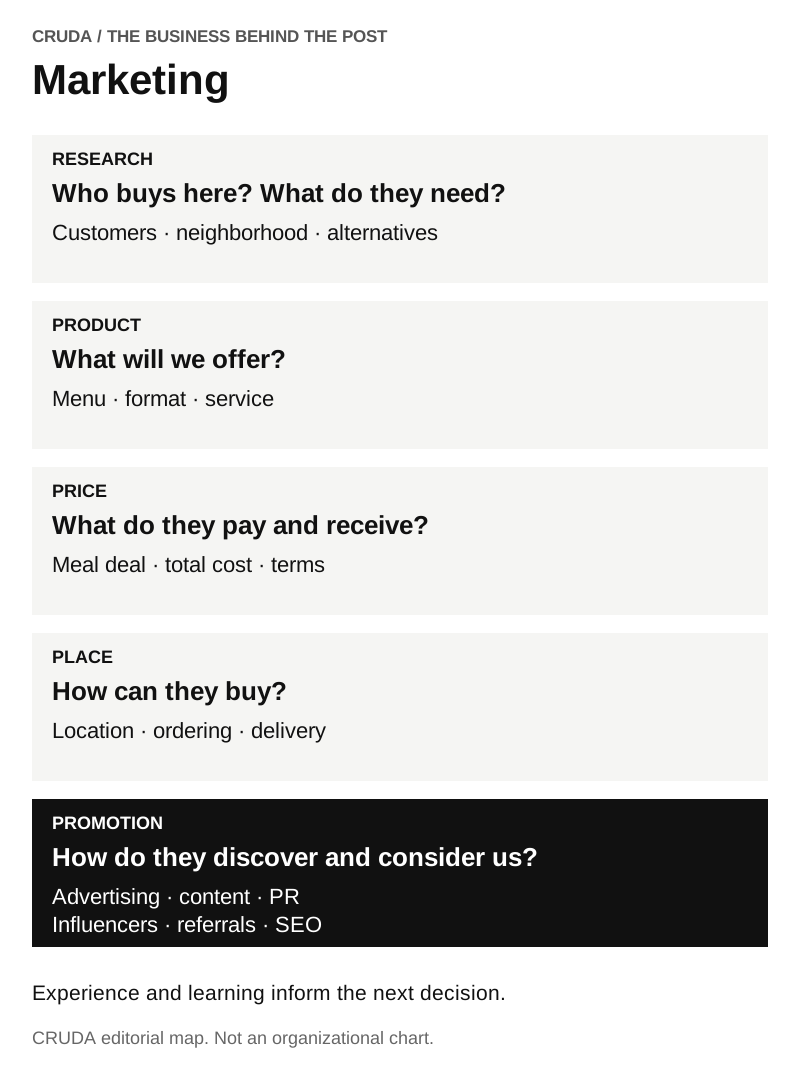
The four Ps: what you sell, what it costs, how people buy and how they hear about it
Product, price, place and promotion organize the marketing mix: decisions about the offer you bring to market. They are not the entire definition of marketing. They are a useful way to organize part of the work.
“Place” means distribution: where and how the offer reaches the buyer.
| Decision | The owner's question | At the burger restaurant |
|---|---|---|
| Product | What does the customer need, and what will we offer? | A lunch that is easy to choose, receive and eat. |
| Price | What do people pay, and what do they believe they get? | A meal deal with a clear total price and terms. |
| Place | Where, when and how can people buy? | The restaurant, digital orders, hours and delivery area. |
| Promotion | How do people discover and consider us? | Communication that makes the offer visible and desirable. |
Product: the burger has to fit the customer's life
Can someone eat it without making a mess before a meeting? Is there an option for the vegetarian in the group? Does it travel well on a twenty-minute delivery ride?
A burger designed to be eaten at a table may not travel well. A huge menu can make choosing harder and slow down the kitchen.
Customer research does not come afterward, simply to work out how to persuade people. It helps decide what to offer.
Your taste can start the business. It cannot replace knowing the customer.
In services, the equivalent is defining scope, timing and responsibilities around what the buyer needs to solve. “We do everything” does not necessarily make buying easier.
Price: customers compare what they pay with what they believe they receive
The restaurant advertises an attractive price. Add a drink, fries and delivery, and the total looks very different.
The final price may be reasonable. Discovering it that way can still undermine trust.
The opposite happens too: an offer seems expensive until you understand what is included.
Pricing involves costs and margins, but also alternatives and perceived value: what customers think the offer is worth. Copying a competitor or charging more because “we are premium” is not a substitute for that work.
In B2B—when one business sells to another—the question is just as concrete: does the buyer understand the difference between your proposal and the cheaper one?
If a meaningful difference exists but is not understood, communication may be missing. If there is no relevant difference for that buyer, new wording will not create one.
Place: make buying possible and easy
Someone watches the video and wants to order. They visit the profile, cannot find the menu, send a message and get an answer an hour later. Then they discover delivery is unavailable in their area.
Communication created interest. The business could not serve it.
Location, delivery coverage, hours and availability determine how the offer reaches the market. In another industry, the obstacle may be a distributor without stock or a quote that takes a week.
Marketing needs to identify those difficulties and work with the people who can solve them. Operations, sales and technology do not therefore have to report to marketing. The buyer's experience crosses the whole company.
Promotion: give someone a reason to pay attention
Now we reach advertising, content, public relations, influencer marketing, referral programs and SEO—the work of helping people find you in search engines—among other tools. They can all contribute to promotion. They are not the whole of marketing.
Our restaurant has something specific to communicate: an easy-to-order lunch for people working nearby. A video can make it desirable. An ad can reach more people. A recommendation can give someone confidence to try it.
This is important work. The mistake is expecting it to compensate indefinitely for an unresolved offer.
Mark Ritson, a marketing educator and consultant, criticizes proposals that replace the four Ps with digital activities and leave out price, product and distribution. In our example, a plan for posting and generating inquiries is still incomplete if nobody asks what we sell, what it costs or how people buy it. Source: Ritson's own article.
What are you buying when you buy “marketing”?
It depends. That ambiguity costs money.
One person may be excellent at producing videos. Another can manage ads. Another can design a visual identity. These are different capabilities.
A hook, for example, is an opening designed to keep someone watching or reading. It might be a good question, an unexpected scene or a relevant statement. Knowing how to create one is useful. It does not, by itself, demonstrate the ability to research buyers, review prices or develop an offer.
If you hire someone to create content, you need good content. Do not assume you have also bought a complete business strategy.
Before comparing proposals, ask which decisions each provider will address. Otherwise, you can end up comparing numbers of posts when you needed to compare capabilities.
Where do the brand, name and logo fit?
The restaurant must decide what it wants to be remembered for. Solving weekday lunch? Being the place to meet friends? Offering a special dining experience?
At CRUDA, positioning means the space you want to occupy in your customer's mind and, where appropriate, their heart.
Choosing that space has consequences. If you want to be the reliable lunch option, punctuality matters. If you want friends to stay for a while, space and service matter.
A brand develops through what people recognize, expect and associate with the business. Identity is the set of elements used to present it and make it recognizable. They are not exactly the same thing.
| Work | What it helps the business do |
|---|---|
| Brand strategy | Decide what we want to mean to customers and how to sustain it. |
| Brand architecture | Decide whether another offer uses the same name, an extension or a separate brand. |
| Naming | Choose the name that identifies the offer. |
| Visual and verbal identity | Build a recognizable appearance and way of speaking. |
| Copywriting | Write to explain, create interest and help people make a decision. |
| Digital experience | Make viewing the menu, choosing and ordering straightforward. |
| Design system | Keep rules and components consistent across screens, buttons and forms. |
| Communication strategy | Decide what to explain, to whom, where and why. |
| Public relations, or PR | Develop relationships and opportunities for presence in media and other relevant settings. |
| Content and advertising | Create and distribute messages that support those goals. |
These are not identical building blocks: some are strategies, others disciplines or systems. They work together.
A website can communicate and sell. A menu can express a personality and make choosing easier. Form has practical consequences.
Substance before appearance: understand what you want to express before deciding how it looks.
If you are considering an identity change, first distinguish whether you need a rebrand or a clearer explanation of what your company already does.
When someone needs what you sell, do they remember your business?
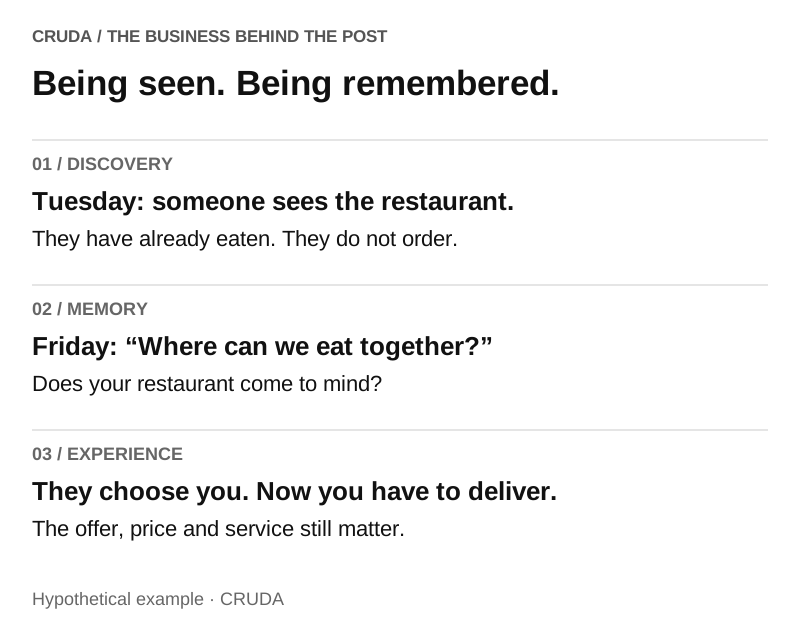
Not everyone who sees a post wants a burger at that moment.
Some have just eaten. Others discover you on Tuesday but are going out with friends on Friday.
If you evaluate every contact solely by immediate purchases, you miss part of the job: making the brand come to mind when a need arises.
“Where can we order something that will arrive before the meeting?”
Does your name come up?
“One of our friends is vegetarian. Where can we all eat?”
Is your restaurant associated with that possibility?
That is what building associations in memory means: connecting a brand with a situation someone may encounter. Recognizing the logo when it is in front of them is not enough. Remembering it when they are not looking at your advertising matters too.
Jon Lombardo and Peter Weinberg, cofounders of research company Evidenza, explain this connection between memory and buying. Their work helps frame a practical question: which situations should make someone think of your business? This section's opening question is CRUDA's editorial interpretation, not a direct quotation. Source: Lombardo and Weinberg.
If you sell machinery or services purchased only every few years, many future customers will not be shopping today. You can become known and understood before they begin looking for suppliers.
This distinction is the starting point for exploring the so-called 95–5 rule in another article. Here, the principle matters: being outside a buying window does not mean someone is not a future customer. We will not treat those percentages as universal or as the percentage who actually purchase.
Attention is not the same as brand equity
The restaurant posts a funny video. Thousands see it. What happened to the brand?
It may have become associated with something desirable. It may have gone unnoticed behind the joke. It may have put people off.
Views alone cannot distinguish those outcomes.
Brand equity refers to the additional value associated with being that brand: how its name and associations change people's response. It is not another word for fame or an isolated positive reaction.
Brand sentiment addresses a different question: how people feel about it. That can include liking, indifference, rejection or nostalgia. Understanding it takes research; visible comments do not automatically represent all buyers.
More people knowing you does not guarantee more people wanting to choose you. That is why “there is no such thing as bad publicity” is not a serious principle for running a company.
Attention creates an opportunity. What people understand and remember afterward matters. We will explore that distinction separately while keeping this article focused on the full responsibility of marketing.
Liquid Death: asking an agency to make something interesting after everything is decided
Liquid Death is an American brand that began selling canned water. Its name and presentation depart from the calm, healthy image usually associated with water.
Founder Mike Cessario came from advertising: his work involved finding ways to make other companies' products interesting.
In his conversation with Jon Evans, host of the marketing podcast Uncensored CMO, he describes a sequence that deserves attention. A company decides on the product and name, commissions the design and then seeks an agency to make people care. His alternative is to involve people who understand culture and behavior earlier, while they can still influence the offer and its presentation. This paraphrases the argument recorded in our listening notes; it is not a verbatim quotation. Original interview.
The problem is not having a business degree or hiring a designer. It is closing important decisions without sufficiently considering the buyer, then asking communication to bridge that gap.
At our restaurant, that would mean choosing the location, menu, price and service around the owner's preferences. When sales prove difficult, the agency is asked to “make something go viral.”
Bring the right people in earlier and you can still change the meal deal, simplify ordering or discover an underserved occasion. Creativity can help shape the offer as well as produce the ad.
An agency can help explain an offer and make it desirable. Do not expect it to invent relevance while being unable to change anything you offer.
We explore the case in Liquid Death: marketing starts before launch.
Does that mean content does not matter?
It matters. A valuable offer can go unnoticed or be poorly explained.
Gary Vaynerchuk, known as GaryVee, is an entrepreneur and communicator who consistently advocates producing content. He has also stated that great marketing will not fix a bad product. Even a prominent advocate for content recognizes communication cannot solve everything. Original post.
Our precise formulation is this: posting more does not, by itself, fix an unwanted offer, a misunderstood price or a difficult purchase. Researching and changing those decisions is marketing too.
You do not have to wait until everything is perfect. The questions you receive can improve the offer and how you explain it.
Rory Sutherland, an Ogilvy advertising executive who explores how perception influences decisions, adds another nuance: communication can change the value we attribute to something without physically changing the product. At our restaurant, explaining a relevant difference can help people appreciate it. That matters; it does not remove the obligation to deliver what was promised. Sutherland's TED talk.
Before asking for more content, identify the difficulty
“We need more sales” is a goal. It does not yet explain what is preventing it.
| What you observe | What to investigate |
|---|---|
| People do not know us. | How potential buyers discover their options. |
| They know us but do not consider us. | When we come to mind and what people expect from us. |
| They inquire but do not understand the offer. | What is confusing or missing. |
| They compare only on price. | Which differences they value and can verify. |
| They want to proceed but abandon the purchase. | Which condition, doubt or step gets in the way. |
| They buy once and do not return. | What they experienced and what they expected. |
These are research questions, not automatic diagnoses.
At your next meeting, reconstruct a purchase that happened and one that fell through. What each person needed. How they arrived. What they compared. What they asked. What influenced the decision.
Separate what you know from what you assume. Then choose what to change, who should participate and what signal would show improvement.
You might need more visibility. You might need a simpler offer, revised terms or an easier purchase.
If the problem is that everyone promises the same thing, continue with differentiating a B2B company beyond “quality and service”.
Frequently asked questions
Is marketing the same as advertising?
No. Advertising helps communicate an offer. Marketing also includes understanding the buyer and working on the offer, price and distribution.
Is customer research part of product development?
Yes. Understanding needs, habits and alternatives helps determine what to offer. That research can also change pricing, sales channels and communication.
Can social media generate sales?
It can contribute to sales and, depending on the business, act as a sales channel. Results also depend on the offer, availability and ease of purchase.
Do I need a logo before doing marketing?
No. Researching buyers, choosing an offer and defining how to sell it are already marketing decisions. Identity helps express that offer and make it recognizable.
Should all marketing generate immediate sales?
Different activities serve different purposes. Some help convert current interest; others build knowledge and associations for future decisions. Evaluate them against their objective and connection to the business.
Does a small business need all of this?
It already makes these decisions, even without using these names. It has an offer, a price and a way to sell and communicate. Reviewing them together helps identify priorities without hiring every specialty at once.
The restaurant may need a great video.
It may also need a clearer menu, a meal deal suited to the neighborhood, an easier way to order or a reason to be remembered next Friday.
Marketing means being able to tell the difference.