

The product is finished. The price, calculated. The name, chosen. We have already spoken with suppliers and approved how to sell it. Now we need to get someone to care.
This is where many companies call marketing. They ask for a campaign, a website, or a sales deck that gives people a reason to buy. By then, the decisions that could make the offer more interesting have already been made.
When should marketing start?
Marketing begins at the conception of the business: when you decide who you are going to serve, what you are going to offer and how that person is going to buy and experience it. The brand strategy connects those decisions with the place you want to occupy in their mind and heart. Advertising helps communicate it; It does not replace that work.
Liquid Death, a company that began selling water in cans, allows us to see what changes when someone with advertising criteria participates from the beginning. The question that interests us at CRUDA is what could improve your offer if that look came sooner.
In this article
First: what is Liquid Death?
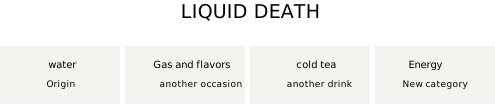
Liquid Death is an American beverage brand. Its name means “liquid death.” It started with canned water and today its catalog includes water, carbonated and flavored drinks, cold tea and energy drinks. To understand its origin, let's stay for a moment with water. [2][4]
Imagine a tall can, with gothic-looking letters and a skull. It might remind you of a beer or an energy drink. However, it contains water. That contradiction is part of the idea: an everyday product presented with an attitude that you don't expect to find there. [3]
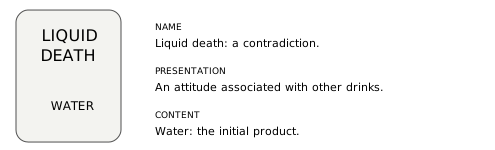
Cessario described among his buyers adults who cut back on alcohol and use the drink on social occasions. Our reading: water can participate in that moment without requiring the usual appearance of a water bottle. It changes what someone carries in their hand and how they present themselves with it. [4]
Who is Mike Cessario?
He is the founder and CEO of Liquid Death. He previously worked for years as an advertising creative: his job was to find ways to make other companies' products catch attention and mean something to people. With Liquid Death he was also able to intervene in what was going to be sold and how it was going to be presented. [4]
The difference matters. If you receive a bottle already designed, you can think of a campaign for it. If you come in early, you can also discuss the bottle, the name, where it will be drunk, and what someone will feel when they hold it in their hand.
This is where the reading of CRUDA begins: the container can fulfill a commercial and cultural function in addition to containing a liquid. That possibility is decided before producing the first advertisement.
Why start with an idea that seems absurd?
In your meetings, a proposal may sound sensible because it resembles something you already know. That makes it easier to approve it. You can also make it end up looking like everything the customer already has to choose from.
Cessario proposes deliberately looking for ideas that at first seem absurd to get away from the usual answers. He explained it to Entrepreneur: it is a way of exploring, accompanied by small tests. Not an instruction to execute any occurrence. [3]
The observation that opens another possibility
Cessario's conversation with Jon Evans, on the Uncensored CMO podcast, left an observation that particularly interests us: many companies build the offer, name it, and only then hire an agency to make it interesting. Incorporating people who understand culture and behavior from the beginning opens up other possibilities. That is the starting point of this article. [1]
The translation for an owner is concrete: invite someone capable of looking beyond how it is manufactured, how much it costs and what margin it leaves to discuss the offer. Someone who asks what the person who meets them will understand and what would make them want to get closer.
The idea needs a reason
In our reading, calling water “liquid death” works as an easy-to-recognize contradiction. Humor is not attached to a finished product: it participates in the name and presentation. For another business, that opportunity may appear in service, the way you get paid, or a simpler shopping experience.
A rare idea is worth advancing when it helps solve something. If it only surprises the board and means nothing to the buyer, there is still a lack of strategy.
The question is what business decision can make the offer more valuable before asking a campaign to make it interesting.
What does brand strategy help you decide?
A brand strategy sets the place you want to occupy for people and the decisions you will make to build it. At CRUDA, positioning means what space you want to occupy in your clients' minds and, when you are looking for a deep connection, in their hearts.
Choosing that place has consequences. If you want to be the option that gives peace of mind to a buyer, it has to be evident in how you hire, deliver and respond. If you want to be part of a fun time, you also need to decide how to live that relationship.
| Decision | business question | What should I be able to change? |
|---|---|---|
| Offer | What does the client need to solve or experience? | Product, scope and experience. |
| Name and presentation | What does he interpret when he meets us? | How the offer is identified and understood. |
| Price and access | Can and want to buy it like this? | Format, conditions and sales channels. |
| Test and service | What do you need to verify to trust? | Demonstration, attention and ability to comply. |
The brand is the set of meanings that people end up attributing to you. The strategy guides the work to build them. Advertising carries messages to the market. They are related tasks, with different scopes.
In Liquid Death, name, can and humor support a recognizable intention. But having someone remember it still doesn't solve whether you find it, buy it, and want to return. To evaluate the case we need to look at what happened in the business.
How much does Liquid Death sell? What the figures say.
There is commercial scale behind the story. The company reported US$263 million in recorded retail sales in 2023. In March 2025 it told Modern Retail that it had reached US$333 million in retail sales by 2024. [5][6]
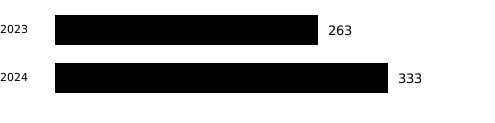
Retail sales means money paid by buyers in stores. It is not equivalent to the income recorded in Liquid Death or its profit. Distributors and stores also participate in that chain.
MicroVentures, a firm linked to investment in the company, published a different figure for 2024: US$240 million of company income. His post explicitly separates that revenue from the $333 million retail. It is reported information, not an audited financial statement that we have reviewed. [7]
And the headlines' $1.4 billion?
It was the valuation announced in a March 2024 financing: how much the company was valued in that operation. It wasn't annual sales or money earned. [5]
This data supports that Liquid Death went much further than a known occurrence on the internet. They do not allow us to calculate how much of the sales were caused by the name, the packaging or each campaign. They also do not prove profitability. The useful question is what decisions made it possible to compete on that scale.
It started with water. The brand could tell something more.
If a company's entire difference depends on a feature that someone else can copy, the advantage is exposed. The example of aluminum, taken up in that conversation, makes it simple: another company can also sell canned water. The brand needs to build something that people associate with it.
In a 2024 interview, Cessario described how Liquid Death went from water to carbonated and flavored drinks and then to iced tea. Their aspiration was to grow in several categories, that is, in different types of drinks. The current catalog also includes energy. [4][2]
Andy Pearson, creative manager of the brand, explained that his team seeks to make people laugh using situations and codes from popular culture. That criterion guides experiences and products in addition to videos. [9]
What is preserved when the product changes
Our reading is that the humor and attitude allow us to recognize Liquid Death even if what is inside the can changes. The promise is not contained in a single characteristic of water. There is a way of introducing yourself that can continue.
For a traditional company, this forces you to think about what your name means beyond the product you started with. A manufacturer may be known for a material, or for its ability to solve a class of projects. That meaning conditions how your next offer will be understood.
There is also a limit: a well-known brand can spark interest in something new, but it does not guarantee that that product will be liked, will have an appropriate price, or will be purchased again. Familiarity opens up a possibility; each offer has to earn its place.
Creativity also has to learn from the market.
History becomes more useful when we stop telling it as an inevitable victory. The same presentation that attracts attention can make someone not understand what they are buying.
In 2025, Marisa Bertha, Liquid Death's chief strategy officer, explained that some people were confusing their drinks with alcohol. He also described smaller cans, new packaging and graphic changes to make it more obvious what each product contained. [6]
Our reading: preserving a personality does not require preserving every initial decision. To reach new consumption situations, it may be necessary to change the format, the entry price or the clarity with which you explain the offer.
A strong brand does not make the product invulnerable
BevNET reported, citing NielsenIQ, a 17.8% drop in dollar sales of Liquid Death's still water line in the 52 weeks ended March 7, 2026. It is a data point for that line in the cited measurement; not of the company as a whole. [10]
It does not allow us to conclude that the entire strategy has failed. It does avoid presenting previous growth as a guarantee of what is to come. We do not locate a verifiable 2025 annual closing of total sales or public audited statements sufficient to affirm its profitability.
What we’d apply to your company
Defend what makes the brand recognizable and review what makes it difficult to understand, buy or use it. They are different questions. A successful campaign does not eliminate a price objection, a bad experience, or a product that is no longer of interest.
The 2026 data is preserved with its specific scope. It is not combined with total sales from other years to draw a group trend.
What can a company that does not sell water learn?
Let's get back to your business. You may sell materials, professional services, or industrial maintenance. You don't need to be like Liquid Death to take advantage of observation: there are pre-campaign decisions that change the value of what you offer.
A hypothetical example: industrial maintenance
The company is preparing a new service. It organizes it by tasks: inspection, spare parts and visits. The budget is ready. Marketing is charged with making it attractive.
Now let's move that conversation forward. A plant manager could explain that their biggest concern is stopping production and not knowing who will respond. It would still need to be investigated: it is a hypothesis about the buyer, not a finding from a CRUDA client.
If that concern is confirmed, the offer could change: emergency care, spare parts available, a responsible person and clear response conditions. Costs, coverage and price would also change. The promise would have a structure to be fulfilled.
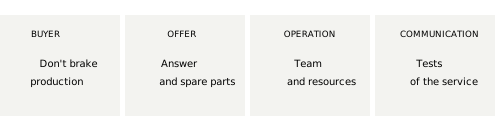
The company could aspire to take the place of a trusted partner when the operation is under pressure. Your advertising would have concrete evidence to show: how you work, who responds, and what the contract includes.
That translates Cessario's criteria to a very different business. Creative opportunity appears by looking at the customer's situation while it is still possible to design a better response.
Finding it and buying it are also part of the strategy.
An offer can be of interest and still lose a sale because it is not available when needed. That's why the place where you sell deserves to enter the brand conversation from the beginning.
In 2021, Live Nation, a company that organizes concerts and operates entertainment venues, announced Liquid Death as exclusive water at many of its venues and festivals in the United States. That relationship put the product in situations where it could be consumed, as well as seen. [8]
In 2025, Liquid Death announced new agreements with distributors on the US West Coast. Behind the humor there was a very specific task: getting drinks to the points of sale. [11]
Translation to a service business
In the industrial example, promising a response is of little use if the customer does not know who to call. In a materials company, showing a product may not be enough if an architect does not obtain samples or information to incorporate into a project.
The opportunity may be in making it easier to request a quote, check a capacity, purchase an initial quantity or get support. They are commercial and operational decisions that also form perception.
Should Marketing decide everything?
No. Management, operations, finance, sales and marketing have different responsibilities. The contribution that we defend is that the client's perspective can modify a decision, not limit itself to receiving it to communicate it.
In a small company, this work can be done by the owner with his team and an external partner. The decisive thing is when that perspective participates and what can change, not the job title or the size of the department.
What to review before the next release.
You don't need to remake the company. Choose an upcoming offer: a service, a line, a branch or a new way of contracting. Review it while there are still open decisions.
1. What changes for the client?
I described a use or purchase situation. What are you trying to solve? What bothers you about how you solve it today? What do you expect to feel? It will separate what you heard from what you assume. Our 5 Cs research crosses culture, context, category alternatives, company capabilities and buyer perspective.
2. What place do we want to occupy?
Define with common words what you want the person to think and feel when they meet you. Then explain what product, service, price, name and experience decisions can build that place. “Leading” does not describe a customer experience.
3. What can we demonstrate and maintain?
Check who delivers what was promised, with what resources and under what conditions. If an idea requires a response that the company cannot provide, adjust the offer before turning it into a message.
4. How do we test before committing?
Show an understandable version to relevant buyers: a test packaging, a service proposal or a purchasing journey. Observe what they understand, what they doubt, and what they would do next. When feasible, try an actual purchase on a small scale. Just because an idea is liked does not prove that someone is going to pay for it.
A useful review ends with a decision: change something, prove a specific doubt, or move forward because the evidence is sufficient. The goal is that the research can influence the business before the campaign has to explain everything.
Frequently asked questions: bringing the idea to your company.
Are marketing and advertising the same thing?
No. Marketing includes understanding the buyer and working on the offer, price, access and experience. Advertising communicates through advertisements. It can generate interest and help build brand, but it does not replace the ability to deliver what is promised.
Do I need a provocative idea to differentiate myself?
No. The provocation makes sense within Liquid Death's criteria. In your business, a valuable difference might be clarity, an easier way to hire, or a better-designed service. The question is what matters to the buyer and how do you make it recognizable.
What if my business is already up and running?
Each new offer reopens decisions. You can also review an existing one where doubts, objections or purchase difficulties are repeated. Keep what customers value; Investigate what prevents them from understanding or using the rest.
What does the Liquid Death case prove?
It shows a company that incorporated creative judgment into product naming and presentation, grew in retail sales, and expanded its offering. It does not prove that copying their humor produces the same result or that their sales figures equal profits.
How do we know if we are improving?
See if the customer understands the offer, considers it, buys and returns; Also review costs, margin and delivery capacity. Compare periods or tests taking into account changes in price, distribution and execution. Reactions to a campaign are only one part.
Go back to the meeting we started with. Before saying “now we lack marketing”, ask: what would we change if we thought about how the client is going to choose us while we are still designing the business? There the brand strategy has room to work.
Sources and scope.
The interviews confirm statements; the communications, data reported by the company. The translation to the employer and the decision criteria are CRUDA analysis. Commercial causality is not attributed to an isolated piece or decision.
[1] Uncensored CMO · Mike Cessario, episode 125 · 03/13/2024
Conversation chosen by Fran. Personal notes as curatorial origin; official chapters: idea 14:57, innovation 19:30, distribution 31:46 and expansion 53:00. No literal quotes are reproduced without comparison.
[2] Liquid Death · About Us and official catalogue
Brand presentation and visible offer consulted on 11/08/2026. Their promotional claims do not amount to independent results.
[3] Entrepreneur · Interview with Cessario · 12/01/2021
Corroborates the creative resource of looking for absurd ideas and small tests. The founder reports US$100,000 in sales and US$2,500 in marketing in the first month; not US$25.
[4] BeverageDaily · Interview with Cessario · 06/19/2024
Creative career, entertainment, expansion from water to other drinks and limits of differentiating only by ingredients. Opinions and statements of the interviewee.
[5] Liquid Death · Financing release · 03/11/2024
US$263 million in retail sales recorded in 2023, 113,000 points of sale in the US and UK, and valuation of US$1.4 billion. Data communicated by the company.
[6] Modern Retail · Interview with Marisa Bertha · 03/28/2025
US$333 million in retail sales in 2024, according to the company. The strategy director explains changes in size, packs and packaging clarity. It is not a financial audit.
Sources and scope: continued.
[7] MicroVentures · Liquid Death: History and Milestones · 07/22/2025
Publication of a firm linked to investment in the company: distinguishes US$240 million of own income in 2024 from US$333 million of retail sales. His 2025 figure was a forecast.
[8] Live Nation · Agreement with Liquid Death · 05/13/2021
Partner announcement: exclusive water at many of its US venues and festivals. It is not generalized to all events nor is it attributed to an isolated sales effect.
[9] Live Nation · Interview with Andy Pearson · 2024
The creative manager explains humor, music and experiences. Source from a business partner, useful for knowing the stated criteria, not an independent evaluation of effectiveness.
[10] BevNET · March/April 2026 Edition
The indexed text reports, attributed to NielsenIQ, a 17.8% drop in dollar sales of the still water line in the 52 weeks ending 03/07/2026. It is not the totality of Liquid Death. The coverage table and the original NielsenIQ report were not accessed.
[11] Liquid Death · New distributors · 11/19/2025
Agreements on the US West Coast; The brand describes a multi-category platform and the upcoming launch of energetics. The 2026 catalog confirms the current offer.