
Would You Burn Down Your Own House?
Brazil, Thiel, SpaceX, and the difference between owning and depending.

Lula won his fourth term. He came second in the first round and turned it around by about four million votes. I found out on Monday. It made me angry. I won’t dress that up.
This started as anger at Brazil and ended as a question for anyone with people on their payroll: which of yours has something to lose?
I live in Russia. My best friend is Venezuelan. I know what happens when a country votes for the promise again and again. And the reaction I saw everywhere was the same one I had: the insult. They like garbage. They never learn.
But anger explains nothing. So I went looking for an explanation, and found it where I didn’t expect it.
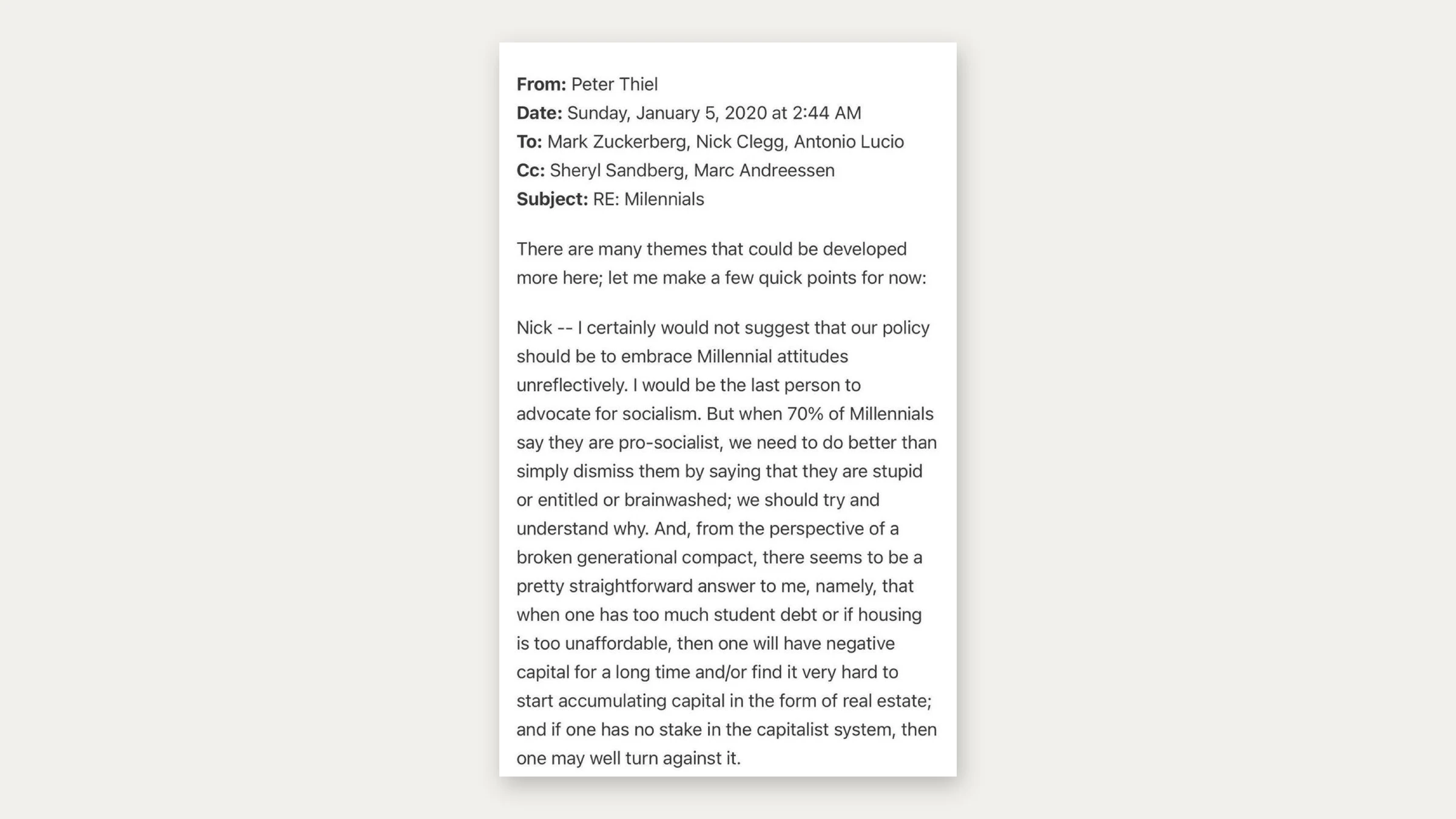
On Sunday, January 5, 2020, at 2:44 in the morning, Peter Thiel sent an email to Mark Zuckerberg and Facebook’s top leadership. Sheryl Sandberg and Marc Andreessen were copied.
Thiel founded PayPal. He founded Palantir. He was Facebook’s first outside investor. Nobody can accuse him of being a leftist.
The subject line was one word: Millennials. Why young people were turning socialist. You’d expect him to mock them. He didn’t.
He says he’d be the last person to advocate for socialism. But when 70% of millennials say they’re pro-socialist, you have to do better than dismiss them as “stupid or entitled or brainwashed.” You have to understand why. And his explanation is simple: student debt and houses nobody can afford. People who can’t start accumulating anything.
Then he closes with this:
“If one has no stake in the capitalist system, then one may well turn against it.”
I read it twice. What I was doing was exactly what Thiel said doesn’t work.
Alex Karp, his partner at Palantir, went further. He told The New York Times there would be no Trump phenomenon without the excesses of Silicon Valley.
Thiel and Karp. Neither of them is on the left. Both see the same thing: whoever is left outside turns, one way or the other. It doesn’t matter which. They go with whoever promises them something.
None of this is new.
That same Monday I interviewed Mark Rukman for the podcast. Mark worked in brand strategy at Meta in New York, and he’s obsessed with history. He told me something I can’t shake: everything has already happened. He explains it with a line from E. O. Wilson, the Harvard biologist: we have Paleolithic emotions, medieval institutions, and godlike technology.
Technology changes. Emotions don’t. The person watching the party from outside feels today what they felt in Athens.
That’s why it repeats. The only thing that changes is who offers something to the person outside. And what they offer.
This is where I part ways with Thiel.
The left sees what he sees: people with nothing at stake. It gets the diagnosis right.
The prescription, no.
It promises you a stake, and gives you dependence.
Having a stake means having something you can lose. A house. A trade. A business. A piece of something you helped build.
A handout isn’t that. You didn’t build it. You can’t grow it. A signature takes it away. You own nothing. You depend on whoever signs.
I’ve lived in Russia for three years. Here the Soviet Union isn’t a chapter in a book. It’s the childhood of the people I talk to every day.
It started with the revolution of 1917. In 1918, private ownership of urban housing was abolished. In 1922, the USSR was born. It lasted almost seventy years.
What people tell me always starts the same way: everything was free. Housing, healthcare, school. No rent. Electricity and gas cost almost nothing.
And that’s true. But hear the rest.
The apartment wasn’t yours. You had a permit to live there, the propiska. You couldn’t sell it or choose it. To get one, you joined a list, and in Moscow or Leningrad the wait could run past ten years. Meanwhile, the kommunalka: several families sharing one kitchen and one bathroom.
Food, the same. From the sixties on, shortages became routine, and by the eighties they were the country’s central problem. Lines for whatever showed up. A string bag in your pocket, in case you got lucky. Ration coupons. Empty shelves.
Everything was free. And nothing was yours.
In December 1991, the Soviet Union ceased to exist. And right after, something happened that almost nobody tells outside Russia: a law let people keep the apartment they lived in. Free, one time only. Nearly half the country’s housing got an owner.
After seventy years, millions of people had, for the first time, something they could lose.
Venezuela? Cuba? Do I need to explain?
A Cuban woman I met in Dubai summed it up in one line: “We don’t even have water.”
That’s what makes me angry. They promise you a house and give you a line.
The answer exists, and it didn’t come from a politician.
After the Second World War, William Levitt built America’s first mass-produced suburbs. He said: “No man who owns his own house and lot can be a Communist. He has too much to do.”
Seventy-five years later, Elon Musk took it further.
SpaceX is his rocket company. The one that flies NASA astronauts to the International Space Station and puts Starlink satellites into orbit, the internet that reaches any corner of the planet. One of the most valuable companies in the world.
For years, SpaceX paid in stock at every level. Engineers, yes, and also cooks, welders, and the people in the cafeteria. Less salary, more ownership. When it went public in June, more than four thousand employees were expected to become millionaires.
The SpaceX welder doesn’t vote to burn the system down. He owns a piece of it.
That’s collaboration: sharing ownership, not dependence. That’s the answer. The left isn’t.
Now you.
Your company is a system. A small one, but a system.
If your people only have a paycheck, they have nothing at stake. They comply, but they don’t care. The day things get hard, they defend nothing, because nothing there is theirs.
You don’t have to be SpaceX. You can make someone the owner of a result, of a decision, of a piece of the story your company tells. People defend the story they have a part in. The one they watch from outside, they criticize.
If your company falls tomorrow, who on your team loses something?
And who doesn’t?
I never went to college. Today, to me, it’s good for networking and not much else. What gave me a stake wasn’t a degree. It was judgment: thinking for myself, and checking what the books say against what happens on the street.
I’ve worked with very idealistic people. Lots of theory, lots of books, little checking against reality. I never saw them working a weekend. For years I thought the problem was that they didn’t want to.
Now I think many of them never had anything to lose. And that the only one who offered them something was the one who promised them everything without making them owners of anything.
The anger is still there. But now I know who it’s for.
Would you burn down your own house?
No. Nobody burns what’s theirs.
That’s why the left doesn’t give you a house.
It gives you a match.
Fran
When you’re ready, three ways to go further:
Reply and tell me what you’re working on. I read every answer.
Book a Narrative Sparring Session. Two conversations and a written diagnosis.
Work with us. See how we work →
Narrative Sparring is a weekly letter on how the people who build things can learn to tell their story. Subscribe at thecruda.com.