
I’m From the Government, and I’m Here to Help
Twenty-nine thousand government websites had been speaking for themselves for years, and nobody was listening.

I
On August 12, 1986, Ronald Reagan told a press conference that the nine most terrifying words in the English language were I’m from the government, and I’m here to help. The line survived forty years because anyone, in any country, got the joke without needing it explained.
On September 29, 2026, Tony Robbins walked onto the stage of the Andrew W. Mellon Auditorium, a few blocks from the White House, and quoted it again. This time he used it to name the problem the event had come to solve: changing the relationship between citizens and their government. What came next was a masterclass in something almost no founder does well, and the largest state in the world had just done it better than most startups.
II
Before anyone saw the product, there was a countdown.
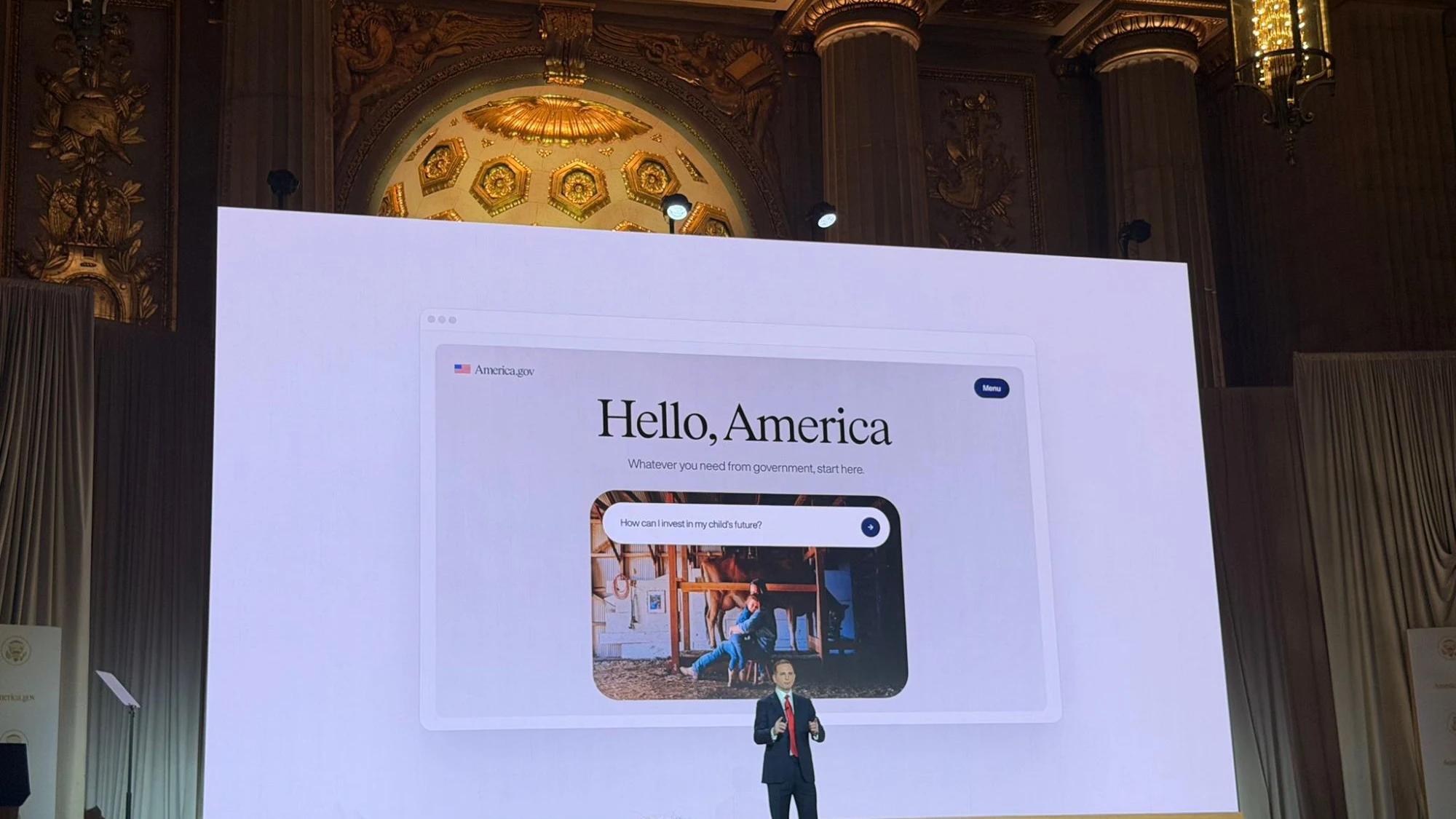
The America.gov homepage showed a giant clock until the moment of launch, like any startup that knows anticipation is designed too. The event was called “Hello, America,” hosted by the National Design Studio, the office run by Joe Gebbia, Airbnb co-founder and the first Chief Design Officer of the United States.
The ceremony didn’t open with the website.
It opened with a video of ordinary people fighting bureaucracy: endless phone calls, layers of paperwork, fax machines. Robbins put the enemy into words everyone recognizes: “Anybody here who’s been to the DMV knows exactly what I’m talking about.” Then he said something that turned a political issue into a human one: the left, the right and the center agree that government has to serve its people better. He talked about a government that respects your time, and about complexity as the enemy of execution (watch his remarks).
Gebbia framed the problem in a single idea: “Everything the internet has transformed, there’s one thing that hasn’t caught up.” That one thing is the everyday experience of government (watch his talk).
He gave the number that makes the problem weigh: about 40 million people visit a federal website every day, and on the other side they find systems that ask them to print, fax or call. America.gov brings together the information of roughly 29,000 government websites behind a single front door.
To show the product, he chose one person: Emily, a newly married woman who has to change her last name on her passport, her taxes and every agency in between. He explained that this used to take weeks, multiple filings and jumping from site to site, assuming you even knew where to start. In the demo, she enters her new name, uploads her marriage certificate, and the change goes out to every agency in a few steps. At that moment, the greeting on the screen changed from “Hello, America” to “Hello, Emily.”
Then each owner showed their part.
Secretary of State Marco Rubio demoed the passport: enter your details, upload your photo, track the approval and the shipping.
Dr. Mehmet Oz, who runs Medicare and Medicaid, showed the health side. The homepage, when you open America.gov, has a single line: “Hello, America. Whatever you need from government, start here.” Gemini and Grok run under the hood, but the word “AI” isn’t in that line.
There’s one detail the event didn’t underline, and it’s worth keeping in mind. Today’s version only answers questions: it explains the steps to renew your passport, but it doesn’t file anything for you yet. According to Gebbia, completing forms and tracking applications will arrive in 2027. They launched a vision on top of a phase-one product.
III
Run the exercise backwards. The same product, the same 29,000 websites, the same AI under the hood, announced with a press release and a link. A line in the Federal Register, an article or two in the tech press, one more website among the 29,000. The product would have existed all the same. For the people, it wouldn’t.
What happened in that auditorium was narrative craft, and you can take it apart piece by piece.
First, they named the enemy the audience already hated, the DMV and the fax, before showing a single screen. Then they chose one person with one concrete task instead of explaining an infrastructure, because nobody gets excited about 29,000 websites and everybody knows someone who got married and lost weeks changing their last name.
They measured value in time given back: weeks against a few clicks. They wrote a promise that a retiree who just wants to collect his pension understands, without knowing what Gemini is. They had each owner show their part, so the promise had a face.
Robbins added the piece most people miss. He framed the problem as something everyone agrees on, regardless of how they vote. When the center of the story is the citizen who pays taxes and loses hours, the story stops belonging to a side and starts belonging to whoever lives it.
Phase one teaches something too. When you tell the destination before you arrive, the gap between what you promised and what you delivered becomes part of the story, and if you don’t mark it yourself, someone else will. By the next day, several outlets were already writing about what America.gov can’t do yet. Telling the vision is part of the craft. Saying clearly what works today is too.
IV
The United States government gave a website that brings forms together a stage, a countdown and a live demo. How did you launch the last thing you built?
Think about it with the same pieces. What’s your customer’s DMV, the thing they already hate before they meet you and that you don’t need to explain? Who’s your Emily, that one person with one concrete problem who makes anyone say “that happened to me”? How many hours do you give back, and have you ever said it in those terms?
Show your homepage to someone in their seventies who doesn’t know what SaaS means. If in ten seconds they can’t tell you what you do for them, the problem is the story, and the product can still be excellent.
Most founders I know believe their work speaks for itself. Twenty-nine thousand government websites had been speaking for themselves for years, and nobody was listening.
V
I look at this from a very specific place. I was an immigrant in the UAE, I am an immigrant in Russia and Spain, and every year I spend dozens of hours, sometimes entire days, on paperwork. Requesting criminal record certificates. Finding someone who can help me understand how to get or renew a visa. I pay taxes like anyone else, and part of what I pay comes back to me as lines, forms nobody can explain and windows that send you to another window.
For a long time I was angry at the person on the other side of the glass. Over the years I understood that she doesn’t see the whole system either. She’s trapped in the same design I am, completing one step of a process nobody thought through from the side of the person waiting.
Gebbia didn’t blame a single employee on that stage. He blamed the design, and offered a new one.
That’s why this matters to me far beyond the United States. Every country collects taxes and every country asks its people for their time. A state that respects that time, and knows how to tell people it does, is something any citizen understands, no matter who they vote for.
VI
Of the whole presentation, I keep coming back to a two-second detail. The screen said “Hello, America” and spoke to an entire country. When Emily finished her task in the demo, it changed to “Hello, Emily.”
A story the size of a country, told all the way down to one person who feels seen. That’s the craft.
Credit where it’s due, whatever you think of who governs: Gebbia and his team did with the state what most companies don’t do with their own products. They told it from the side of the person waiting in line.
Reagan turned nine words into the most repeated joke about government. Forty years later, someone put them back on a stage to try to make them a promise again. We don’t know yet if they’ll keep it. What we already know is that, if nobody had told the story, nobody would have known they were trying.
The six pieces
What they did in that auditorium works for any company, from a three-person startup to a corporation. Before your next launch, run it through these six pieces:
- The enemy. Every great story has one: David had Goliath, Ali had Frazier, Messi had Cristiano. Name the old way your industry still accepts, before you say what you do. They named bureaucracy: the DMV, the fax, the paperwork.
- The person. Tell one client’s story, with their name and their problem. They told Emily’s: just married, changing her name on her passport and her taxes.
- The line. Write your promise so a retiree could repeat it. Theirs: “Whatever you need from government, start here.”
- The time. Measure value in hours given back: weeks of filings against one document and a few clicks.
- The faces. Have each owner show their part. Rubio showed the passport; Oz showed Medicare.
- The now. Tell people where you’re going and mark clearly what works today. If you don’t mark it, someone else will.
Subscribe to Narrative Sparring.